Electromagnetism & electronics
Hybrid stepper motor
Electromagnetism · Motors
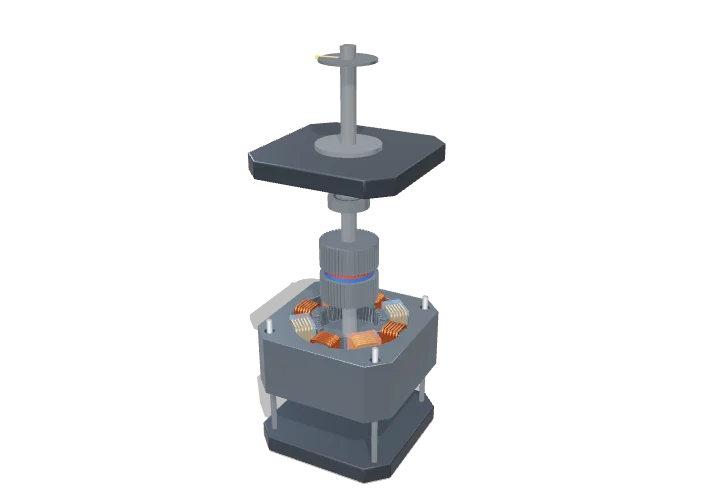 Open the interactive 3D model →
How does a 3D printer move its nozzle to exactly the right spot, again and again, without measuring it?
A stepper motor does not spin smoothly like a fan motor — it turns in tiny, exact clicks, 200 per full turn. Its centre has rows of little teeth and a magnet, and the outer part has electromagnets that can be switched on and off in turn. Each switch pulls the teeth round by one click, so counting the clicks tells you exactly how far it has turned.
A hybrid stepper motor converts each change in the currents of its two phase windings into a fixed increment of shaft rotation, typically 1.8° (200 steps per revolution). It combines toothed variable-reluctance geometry with an axial permanent magnet, so the rotor is pulled into a definite position set by which stator poles are north or south.
Key facts
- Full-step angle
- 1.8° (200 steps rev⁻¹); 0.9° types also common
- Rotor teeth
- 50 per cap, two caps offset by 3.6°
- Stator
- 8 poles, typically 5–6 teeth each at ≈ 7.2° pitch
- NEMA 17 frame
- 42.3 mm square
- Holding torque (NEMA 17)
- ≈ 0.2–0.6 N m
- Rated phase current
- ≈ 0.5–2 A
Parts you can explore (10)
- Stator core
- Phase A windings
- Phase B windings
- Rotor caps
- Permanent magnet
- Shaft
- Bearings
- Front end bell
- Rear end bell
- Lead wires
In the 3D model
Rotate and take apart the model, follow a guided tour of what each part does and why it’s needed, change it with a live slider, and test yourself with a short quiz. Free, no sign-up.
Open Hybrid stepper motor in 3D →
OpenArc Models’ models are simplified teaching schematics. Terms · Privacy