Power & energy
Stellarator
Fusion energy · Magnetic confinement
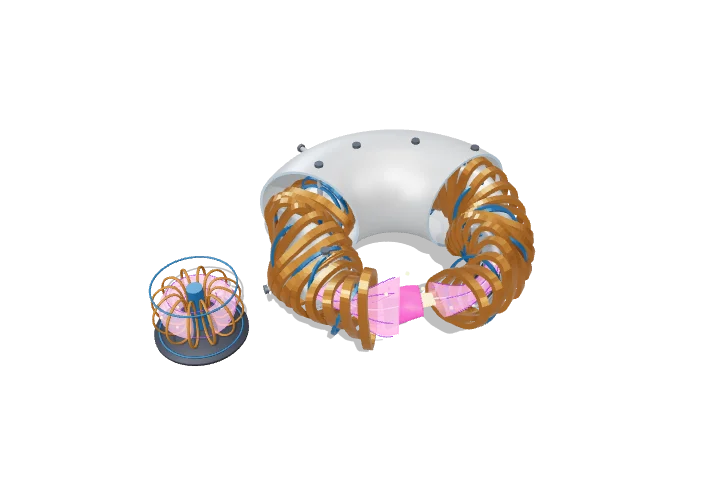 Open the interactive 3D model →
How do you hold a gas hotter than the Sun’s core when any wall it touches would melt?
Fusion power needs hydrogen gas heated to over 100 million degrees, so hot that its atoms break into charged particles called a plasma. Charged particles are steered by magnetism, so a stellarator traps the plasma inside an invisible cage of twisted magnetic field, made by oddly bent electromagnets wrapped around a doughnut-shaped chamber. The twist is the key: without it the plasma would drift out and hit the walls in a fraction of a second.
A stellarator confines a fusion plasma in a twisted magnetic field produced entirely by external, three-dimensionally shaped coils, so no current has to flow in the plasma. Wendelstein 7-X in Greifswald, Germany, is the largest optimised stellarator and tests whether this route can match the tokamak while running continuously.
Key facts
- W7-X major / minor radius
- 5.5 m / 0.53 m (plasma volume ≈ 30 m³)
- Magnetic field on axis
- up to 3 T (standard 2.5 T)
- Coils
- 50 non-planar + 20 planar, superconducting NbTi at ≈ 4 K
- Field periods
- 5
- Rotational transform
- ι ≈ 0.85–1.0 (set by the coils)
- First plasma
- 10 December 2015
Parts you can explore (11)
- Plasma
- Flux surfaces
- Magnetic axis
- Field lines
- Non-planar coils
- Planar coils
- Plasma vessel
- Divertor
- Ports
- Cryostat
- Tokamak comparison
In the 3D model
Rotate and take apart the model, follow a guided tour of what each part does and why it’s needed, change it with a live slider, and test yourself with a short quiz. Free, no sign-up.
OpenArc Models’ models are simplified teaching schematics. Terms · Privacy