Mechanisms
Rack-and-pinion steering
Mechanisms · Vehicle dynamics
 Open the interactive 3D model →
When you turn a corner, why don’t both front wheels of a car point the same way?
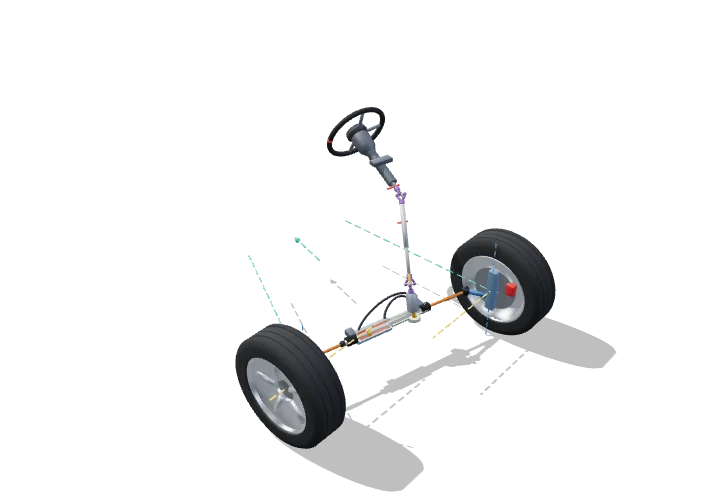
Turning the steering wheel spins a small gear that slides a toothed bar sideways under the car. Rods on each end of that bar push and pull the front wheels so they swing left or right. The rods are angled so the inside wheel turns a bit more than the outside one, because it travels round a smaller circle.
A car’s steering system turns rotation of the steering wheel into small, precise rotations of the front wheels about their kingpin axes, via a column, universal joints, a rack-and-pinion gear, tie rods and steering arms. The linkage is laid out so that in a turn the inner wheel steers more than the outer one (Ackermann geometry), letting both tyres roll about a common centre without scrubbing.
Key facts
- Overall steering ratio
- ≈ 12–20 : 1 (this model ≈ 19.5 : 1 on centre)
- Lock to lock
- ≈ 2.5–3.5 turns (model: 3 turns)
- Pinion
- 7 teeth, 7.35 mm pitch radius → ≈ 46 mm rack travel per turn
- Max road-wheel angle
- ≈ 35–40° inner (model: 32.5° inner, 27.2° outer)
- Wheelbase / track (model)
- 2.70 m / 1.28 m between kingpins
- Hydraulic assist pressure
- up to ≈ 100–130 bar at parking
Parts you can explore (12)
- Steering wheel
- Steering column
- Universal joints
- Intermediate shaft
- Pinion and valve
- Rack
- Rack housing
- Power-assist cylinder
- Tie rods
- Steering arms and knuckles
- Front wheels
- Ackermann geometry
In the 3D model
Rotate and take apart the model, follow a guided tour of what each part does and why it’s needed, change it with a live slider, and test yourself with a short quiz. Free, no sign-up.
Open Rack-and-pinion steering in 3D →
OpenArc Models’ models are simplified teaching schematics. Terms · Privacy