Power & energy
Steam turbine
Power generation · Impulse–reaction, condensing
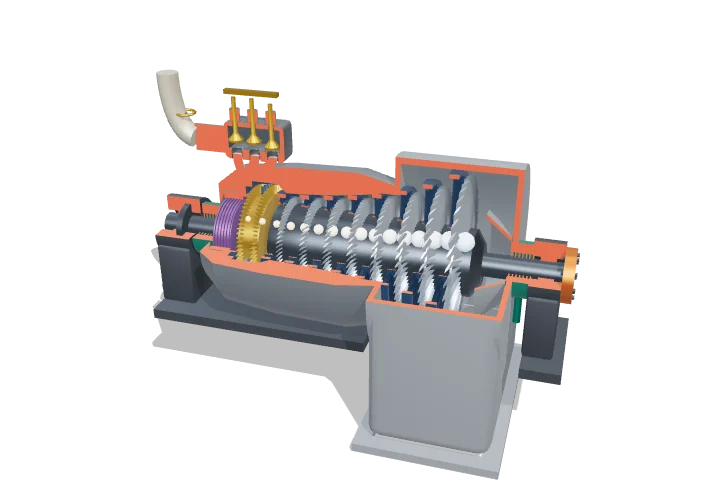 Open the interactive 3D model →
Most of the world’s electricity comes from steam spinning a shaft — how does steam turn a heavy steel rotor?
Steam from a boiler is let out through rings of small angled nozzles, which turn its pressure into fast jets. The jets push on rows of curved blades fixed to a shaft and spin it, and the shaft turns an electricity generator. The steam does this again and again in many rows, spreading out more at each one.
A steam turbine is the work-producing step of the Rankine cycle: high-pressure, high-temperature steam expands through alternating rows of fixed nozzles and moving blades, turning its enthalpy into jet speed and then into shaft torque. Because the steam’s volume grows hundreds of times between inlet and condenser, each stage is larger than the last, and the machine is a carefully staged expansion rather than a single jet.
Key facts
- This model
- ≈ 60 MW at 3,000 rpm; 90 bar, 500 °C in; 0.08 bar (41 °C) out
- Grid speed
- 3,000 rpm (50 Hz) or 3,600 rpm (60 Hz); half speed for large nuclear units
- Steam volume growth inlet → exhaust
- ≈ 430× here (0.037 → ≈ 16 m³/kg)
- Isentropic enthalpy drop
- ≈ 1,300 kJ/kg here; ≈ 1,100 kJ/kg actually extracted (η ≈ 85%)
- Internal efficiency
- ≈ 85–92% for large modern turbines
- Largest single units
- ≈ 1,750 MW (nuclear, half speed)
Parts you can explore (11)
- Steam chest & governor valves
- Control stage (impulse)
- Nozzle diaphragms
- Rotor blade stages
- Rotor shaft
- Balance piston
- Gland seals
- Casing
- Exhaust hood
- Bearings & coupling
- Steam flow
In the 3D model
Rotate and take apart the model, follow a guided tour of what each part does and why it’s needed, change it with a live slider, and test yourself with a short quiz. Free, no sign-up.
OpenArc Models’ models are simplified teaching schematics. Terms · Privacy