Power & energy
Steam locomotive
Heat engines · Reciprocating steam engine
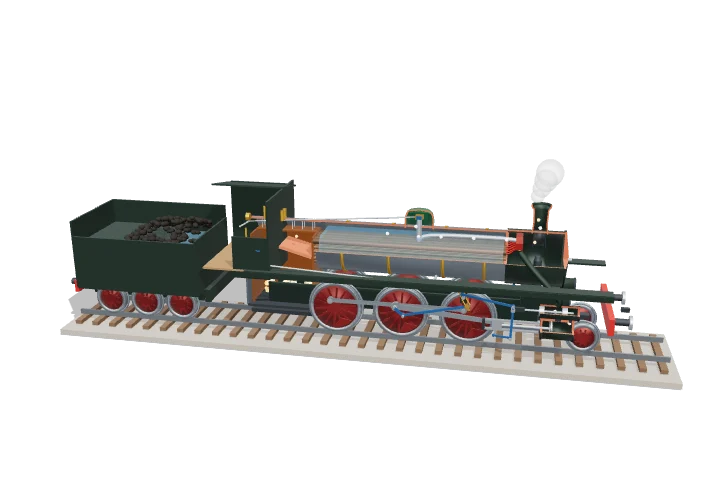 Open the interactive 3D model →
How did burning coal make a 100-tonne locomotive haul a train at 100 km/h?
A steam locomotive carries its own fire, water and engine. The fire boils water into high-pressure steam, the steam pushes pistons back and forth in cylinders, and rods turn that back-and-forth motion into spinning wheels. A clever set of levers decides when steam enters each cylinder, which lets the driver go faster, save coal or run backwards.
A steam locomotive is a complete, self-contained power plant on wheels: a coal fire boils water in a fire-tube boiler, and the steam drives double-acting pistons whose motion connecting rods turn into rotation of the driving wheels. The Walschaerts valve gear times the admission of steam to each cylinder end, and by varying the cut-off it lets the driver trade pulling power for economy and reverse the engine.
Key facts
- Wheel arrangement (Whyte)
- 2-6-0 “Mogul”: 2 leading, 6 coupled driving, 0 trailing wheels
- Boiler pressure
- ≈ 1.4–2.1 MPa (200–300 psi) in later practice
- Superheated steam temperature
- ≈ 300–400 °C
- Exhaust beats
- 4 per wheel revolution (2 double-acting cylinders)
- Overall thermal efficiency
- ≈ 5–10 % coal to drawbar (rarely above 10 %)
- Steam-traction speed record
- 203 km/h (LNER A4 Mallard, 1938)
Parts you can explore (13)
- Firebox
- Fire-tube boiler
- Steam dome & regulator
- Superheater
- Smokebox & blast pipe
- Cylinders
- Walschaerts valve gear
- Connecting & coupling rods
- Driving wheels
- Frames & running gear
- Cab
- Tender
- Steam & exhaust flow
In the 3D model
Rotate and take apart the model, follow a guided tour of what each part does and why it’s needed, change it with a live slider, and test yourself with a short quiz. Free, no sign-up.
OpenArc Models’ models are simplified teaching schematics. Terms · Privacy