Plants & animals
Sea star
Zoology · Echinoderm
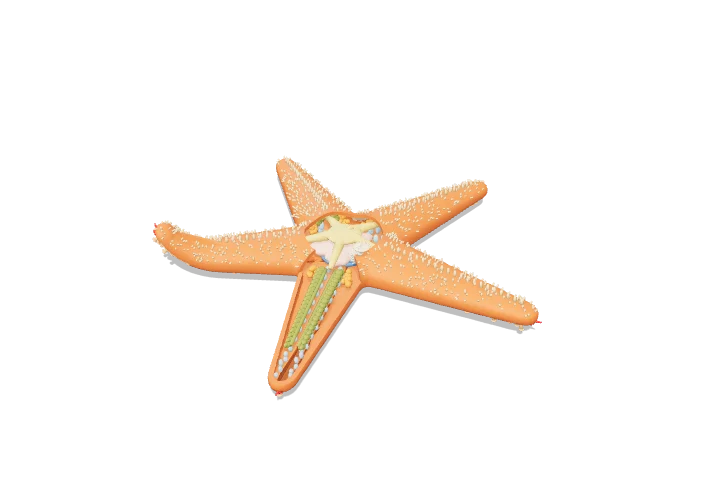 Open the interactive 3D model →
How does a sea star walk on hundreds of tiny feet with no bones and no brain?
A sea star is not a fish: it is a spiny-skinned animal with five arms and no brain. Inside it runs a system of water-filled pipes, and under each arm sit hundreds of soft tube feet. Squeezing a little bulb of water pushes each foot out, like a water balloon, so the sea star walks — and it can even push its stomach out of its mouth to eat.
Sea stars are echinoderms with five-part (pentaradial) symmetry, a skeleton of calcite plates and a unique water vascular system that works as a hydraulic machine. Hundreds of tube feet, each powered by its own muscular ampulla, let the animal walk, cling to rock and pull open mussel shells, while a stomach pushed out through the mouth digests prey outside the body.
Key facts
- Species modelled
- Asterias rubens, the common starfish of north-east Atlantic coasts
- Size
- Typically 10–30 cm across (arm tip to arm tip)
- Arms
- 5, each with an ambulacral groove of tube feet
- Tube feet per arm
- Hundreds, in four zig-zag rows in Asterias
- Skeleton
- Mesodermal ossicles of high-magnesium calcite
- Respiration
- Across tube feet and papulae (dermal gills)
Parts you can explore (13)
- Body wall
- Spines
- Madreporite
- Stone canal
- Ring canal
- Radial canals
- Ampullae
- Tube feet
- Cardiac stomach
- Pyloric stomach
- Pyloric caeca
- Gonads
- Eyespots
In the 3D model
Rotate and take apart the model, follow a guided tour of what each part does and why it’s needed, change it with a live slider, and test yourself with a short quiz. Free, no sign-up.
OpenArc Models’ models are simplified teaching schematics. Terms · Privacy