Astronomy & space
Star life cycle
Astrophysics · Stellar evolution
 Open the interactive 3D model →
Why will the Sun fade away quietly, while a star just 10 times heavier will blow itself apart?
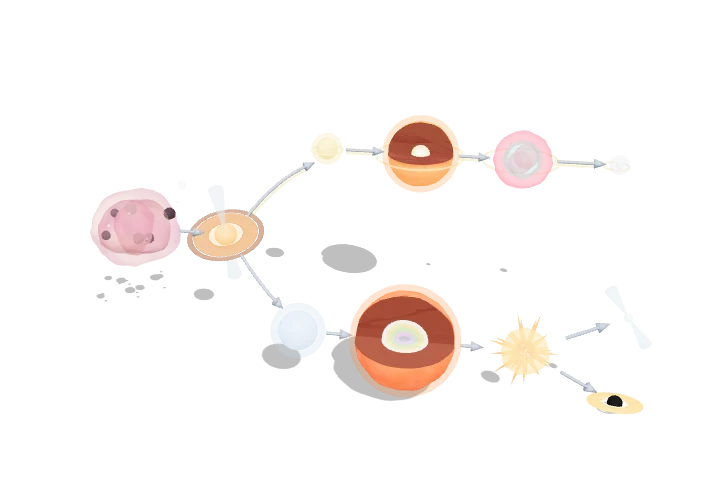
Every star is born in a cold cloud of gas and dust, then shines for most of its life by fusing hydrogen into helium. How it ends depends on how much mass it starts with. Stars like the Sun swell into red giants and leave behind a small white dwarf; much heavier stars explode as supernovae and leave a neutron star or a black hole.
A star’s initial mass determines how fast it burns its fuel, which elements it can fuse and how it dies. Low-mass stars end as white dwarfs after shedding planetary nebulae, while stars above about 8 solar masses explode as core-collapse supernovae and leave neutron stars or black holes.
Key facts
- Hydrogen-burning stars
- ≈ 0.08 M☉ to > 100 M☉
- Sun’s main-sequence lifetime
- ≈ 10 billion years (≈ 4.6 Gyr elapsed)
- White dwarf / supernova divide
- ≈ 8 M☉ initial mass (≈ 7–10 M☉ in models)
- Chandrasekhar mass
- ≈ 1.4 M☉
- Typical white dwarf
- ≈ 0.6 M☉, ≈ Earth-sized (~0.01 R☉)
- Typical neutron star
- ≈ 1.4 M☉, ≈ 20–24 km diameter
Parts you can explore (12)
- Stellar nebula
- Protostar
- Sun-like star
- Red giant
- Planetary nebula
- White dwarf
- Massive star
- Red supergiant
- Supernova
- Neutron star
- Black hole
- Evolution arrows
In the 3D model
Rotate and take apart the model, follow a guided tour of what each part does and why it’s needed, change it with a live slider, and test yourself with a short quiz. Free, no sign-up.
OpenArc Models’ models are simplified teaching schematics. Terms · Privacy