Physics
Damped spring–mass oscillator
Mechanics · Oscillations
 Open the interactive 3D model →
Why does a car bounce once and settle after a bump, instead of bouncing all the way down the road?
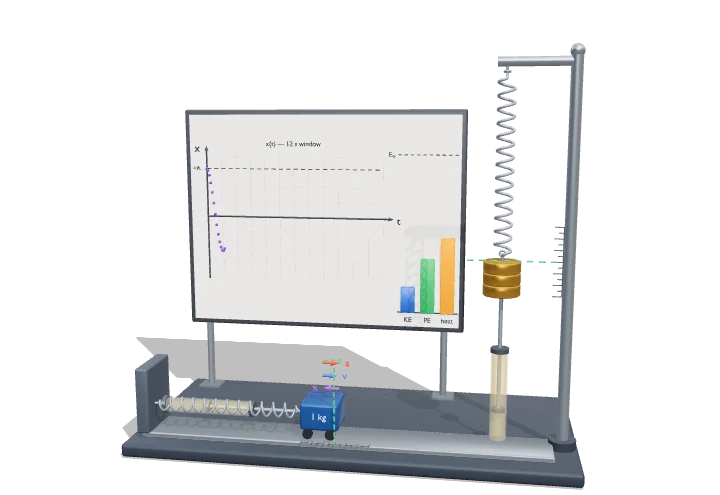
A weight on a spring bounces back and forth because the spring always pulls it back towards the middle. Left alone it would bounce for a very long time, so machines add a damper — a piston in oil — that drains the energy away as heat. Turning the damping up changes the motion from long, fading bounces to a smooth glide back to rest.
A mass on a spring obeys m x″ = −kx and oscillates sinusoidally at ω₀ = √(k/m), trading kinetic and elastic energy. Adding viscous damping −cv turns this into the damped harmonic oscillator, whose behaviour — decaying oscillation, critical return or slow creep — is set by the single dimensionless damping ratio ζ = c/(2√(km)).
Key facts
- Model values
- m = 1 kg, k = 10 N/m, A = 0.25 m
- Natural angular frequency
- ω₀ = √(k/m) = 3.16 rad/s (f₀ = 0.50 Hz)
- Natural period
- T₀ = 2π√(m/k) = 1.99 s
- Critical damping coefficient
- c_crit = 2√(km) = 6.3 N·s/m
- Stored energy at release
- E₀ = ½kA² = 0.31 J
- Static stretch of hanging spring
- mg/k = 0.98 m
Parts you can explore (13)
- Support frame
- Horizontal spring
- Horizontal dashpot
- Sliding mass
- Vertical spring
- Hanging mass
- Vertical dashpot
- Equilibrium and scale
- Displacement x
- Velocity v
- Acceleration a
- x–t graph
- Energy bars
In the 3D model
Rotate and take apart the model, follow a guided tour of what each part does and why it’s needed, change it with a live slider, and test yourself with a short quiz. Free, no sign-up.
Open Damped spring–mass oscillator in 3D →
OpenArc Models’ models are simplified teaching schematics. Terms · Privacy