Human body
Spinal cord and reflex arc
Anatomy · Nervous system
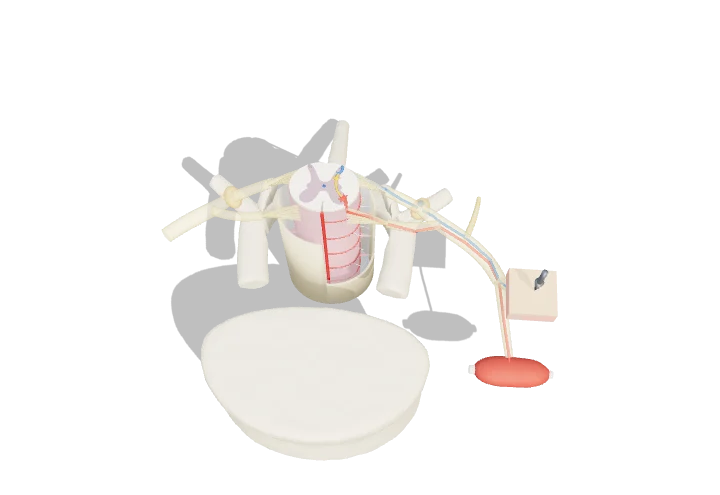 Open the interactive 3D model →
Why does your hand jerk away from a hot stove before you even feel the pain?
Your spinal cord is a thick cable of nerve tissue running down the inside of your backbone, carrying messages between your brain and body. It can also act on its own: a pain signal comes in, passes through a connecting nerve cell, and goes straight back out to a muscle. This shortcut, called a reflex, pulls your hand away before your brain has caught up.
The spinal cord is a cylinder of central nervous tissue in which a butterfly of grey matter (neuron cell bodies and synapses) is surrounded by white matter tracts, wrapped in three meninges inside the vertebral canal. Paired dorsal (sensory) and ventral (motor) roots join into spinal nerves, and circuits within a single segment can turn a stimulus into a movement — a spinal reflex — without the brain.
Key facts
- Length (adult)
- ≈ 42–45 cm, ending at about L1–L2 (conus medullaris)
- Diameter
- ≈ 1 cm; ≈ 11–13 mm wide at the cervical and lumbar enlargements
- Spinal nerve pairs
- 31 (8 cervical, 12 thoracic, 5 lumbar, 5 sacral, 1 coccygeal)
- Withdrawal reflex latency
- tens of milliseconds (polysynaptic)
- Conduction velocity
- Aα motor 70–120 m/s; Aδ nociceptor 5–30 m/s; C fibres 0.5–2 m/s
- CSF volume (whole CNS)
- ≈ 125–150 mL, renewed 3–4 times a day
Parts you can explore (16)
- Grey matter
- White matter
- Central canal
- Pia mater
- Arachnoid mater
- Dura mater
- Dorsal root
- Dorsal root ganglion
- Ventral root
- Spinal nerve
- Vertebra
- Skin & nociceptor
- Effector muscle
- Sensory neuron
- Interneuron
- Motor neuron
In the 3D model
Rotate and take apart the model, follow a guided tour of what each part does and why it’s needed, change it with a live slider, and test yourself with a short quiz. Free, no sign-up.
Open Spinal cord and reflex arc in 3D →
OpenArc Models’ models are simplified teaching schematics. Terms · Privacy