Plants & animals
Orb-weaving spider
Arachnids · Anatomy and behaviour
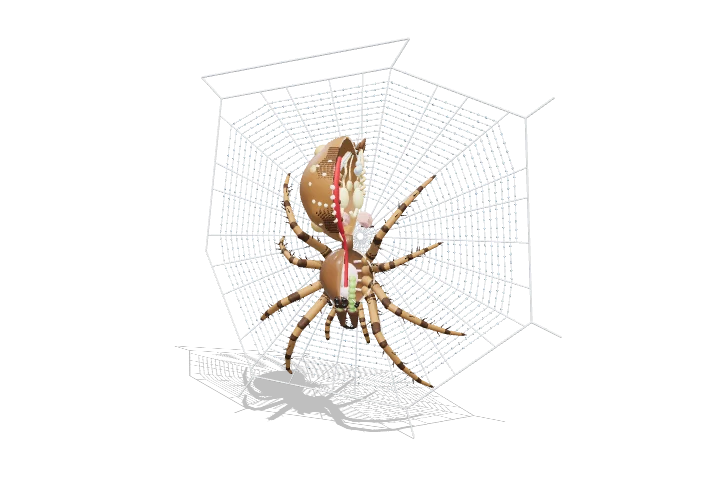 Open the interactive 3D model →
How does a spider spin a trap strong enough to stop a flying insect from thread finer than a hair?
A garden spider has two body parts, eight legs, fangs with venom and a belly full of silk factories. It builds its web in order: first a strong, dry frame and spokes, then a stretchy, sticky spiral. When an insect hits, the sticky spiral stretches to catch it, and the spider feels the shaking through its legs.
Spiders are arachnids with two body regions, eight legs, venomous chelicerae and an abdomen packed with silk glands, book lungs and a tubular heart. Orb weavers such as the garden spider use several silks with different mechanical properties to build a stiff radial scaffold and a stretchy, glue-coated capture spiral.
Key facts
- Species modelled
- European garden spider, Araneus diadematus (female)
- Body length
- Females ≈ 10–20 mm; males smaller
- Legs / eyes
- 8 legs of 7 segments; 8 simple eyes
- Silk gland types
- Up to 7 in orb weavers
- Radii per orb
- ≈ 25–35
- Build time
- Roughly 30–60 min for a complete orb
Parts you can explore (14)
- Cephalothorax
- Abdomen
- Legs
- Chelicerae and fangs
- Pedipalps
- Eyes
- Book lungs
- Heart
- Silk glands
- Spinnerets
- Venom glands
- Central nervous system
- Frame and radii
- Capture spiral
In the 3D model
Rotate and take apart the model, follow a guided tour of what each part does and why it’s needed, change it with a live slider, and test yourself with a short quiz. Free, no sign-up.
Open Orb-weaving spider in 3D →
OpenArc Models’ models are simplified teaching schematics. Terms · Privacy