Astronomy & space
International Space Station
Spaceflight · Orbital laboratory
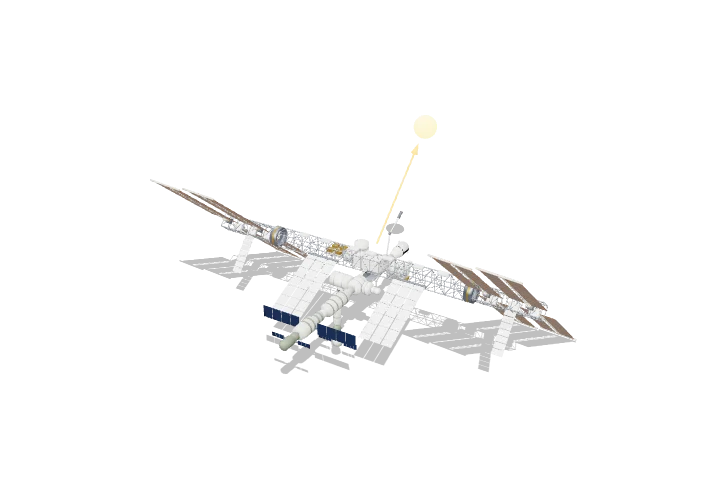 Open the interactive 3D model →
How can astronauts float weightless only 420 km up, where Earth’s gravity is still almost as strong?
The International Space Station is a laboratory as big as a football pitch, circling Earth every hour and a half. It is always falling towards Earth but moving sideways so fast — about 7.7 km every second — that it keeps missing, so everyone inside floats. Giant solar wings turn to follow the Sun and power it, and radiators get rid of the heat.
The International Space Station is a crewed laboratory in low Earth orbit, assembled from more than 40 launches since 1998 by the US, Russia, Japan, Europe and Canada. It orbits about 420 km up every ≈ 93 minutes, drawing power from eight Sun-tracking solar-array wings and rejecting heat through radiators.
Key facts
- Orbit
- ≈ 400–420 km altitude, 51.6° inclination
- Speed / period
- ≈ 7.66 km/s; ≈ 92–93 min
- Size
- ≈ 109 m × 73 m (truss × modules)
- Mass
- ≈ 420,000–450,000 kg
- Pressurised volume
- ≈ 916 m³ (≈ 388 m³ habitable)
- Solar-array area
- ≈ 2,500 m² on eight wings
Parts you can explore (13)
- Integrated truss
- Rotary joints (SARJ and beta gimbals)
- Solar array wings
- Radiators
- Destiny laboratory
- Nodes, Cupola and Quest airlock
- Kibo laboratory
- Columbus laboratory
- Russian segment (Zvezda and Zarya)
- Soyuz
- Dragon
- Canadarm2
- Sun direction
In the 3D model
Rotate and take apart the model, follow a guided tour of what each part does and why it’s needed, change it with a live slider, and test yourself with a short quiz. Free, no sign-up.
Open International Space Station in 3D →
OpenArc Models’ models are simplified teaching schematics. Terms · Privacy