Astronomy & space
Space Shuttle
Spaceflight · Launch vehicle
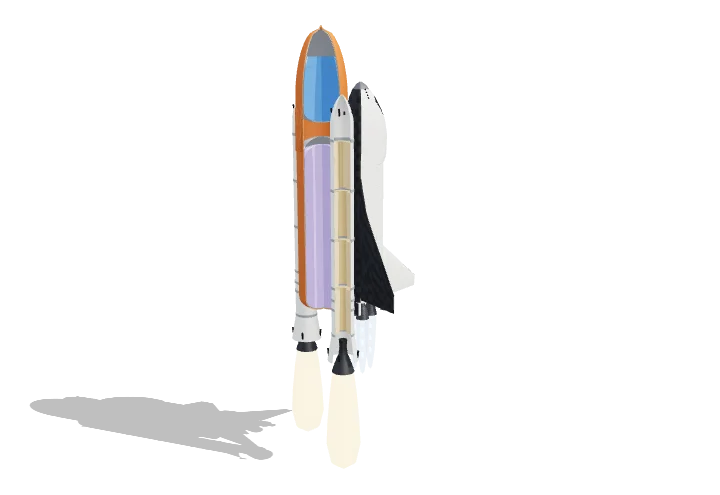 Open the interactive 3D model →
How do you launch a spaceplane the size of an airliner and then land it on a runway like a glider?
The Space Shuttle was a winged spaceplane strapped to a giant orange fuel tank and two white rocket boosters. The boosters and tank pushed it into orbit and then dropped away. After its mission, the spaceplane came back through the atmosphere protected by heat-proof tiles and glided down to land.
The Space Shuttle combined a reusable winged orbiter, two recoverable solid rocket boosters and an expendable external tank into a “stage-and-a-half” launch system that flew 135 missions between 1981 and 2011. Its design shows the trade-offs of reusability: high-performance hydrogen engines and a delicate thermal protection system bought a vehicle that could return crews, laboratories and payloads from orbit.
Key facts
- Liftoff mass
- ≈ 2,000 t
- Liftoff thrust
- ≈ 30 MN (SRBs ≈ 85%)
- Orbiter
- 37.2 m long, 23.8 m wingspan, ≈ 78 t empty
- External tank
- 46.9 m × 8.4 m; ≈ 730 t of LOX + LH₂
- Solid rocket boosters
- 45.5 m × 3.7 m; ≈ 500 t propellant each; burn ≈ 2 min
- Missions
- 135 (1981–2011), five spaceflight orbiters
Parts you can explore (12)
- Orbiter airframe
- Thermal protection tiles
- Payload bay
- RS-25 main engines
- Orbital maneuvering system
- Reaction control system
- External tank
- Liquid oxygen tank
- Liquid hydrogen tank
- Solid rocket boosters
- SRB propellant
- Engine exhaust
In the 3D model
Rotate and take apart the model, follow a guided tour of what each part does and why it’s needed, change it with a live slider, and test yourself with a short quiz. Free, no sign-up.
OpenArc Models’ models are simplified teaching schematics. Terms · Privacy