Electromagnetism & electronics
Linear solenoid actuator
Electromechanics · Plunger solenoid
 Open the interactive 3D model →
What makes a car door lock clunk shut, or a washing machine’s water valve snap open?
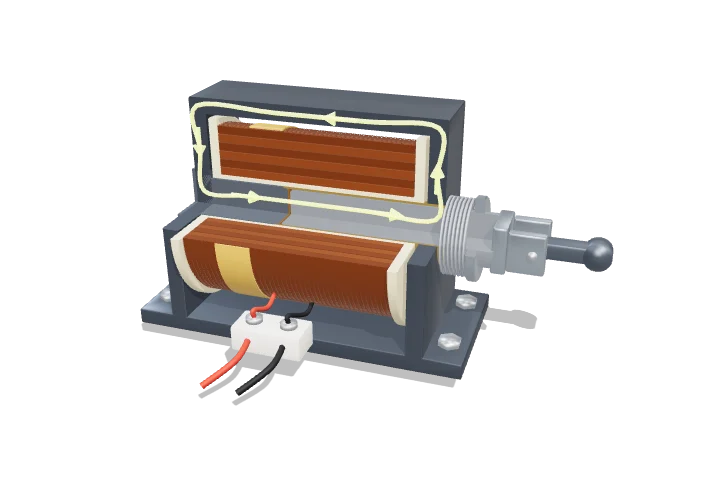
A solenoid is a coil of wire with an iron rod, called a plunger, that can slide inside it. When electricity flows through the coil, it becomes a magnet and pulls the plunger in with a sudden snap. When the electricity stops, a spring pushes the plunger back out.
A plunger solenoid converts electrical energy into short linear motion: current in a coil magnetises an iron frame, and the movable plunger is pulled toward a fixed pole piece because closing the air gap reduces the reluctance of the magnetic circuit. The force rises steeply as the gap closes (roughly as 1/g² until the iron saturates), so a return spring sets the rest position and the load must be matched to this strongly stroke-dependent force.
Key facts
- Force law (ideal, unsaturated)
- F = μ₀ A (NI)² / (2g²)
- Typical strokes
- ≈ 1–25 mm
- Typical forces
- ≈ 1–100 N (small DC types); kN for large industrial
- Response time
- ≈ 5–50 ms (small types); < 1 ms for fast injectors
- Model solenoid
- 2,000 turns, 24 Ω, 6 mm stroke; pulls in above ≈ 0.38 A
- Coil insulation classes
- B 130 °C, F 155 °C, H 180 °C
Parts you can explore (10)
- Coil winding
- Bobbin
- Plunger
- Pole piece (stop)
- Frame (yoke)
- Plunger guide tube
- Return spring
- Clevis & load link
- Lead wires
- Magnetic flux
In the 3D model
Rotate and take apart the model, follow a guided tour of what each part does and why it’s needed, change it with a live slider, and test yourself with a short quiz. Free, no sign-up.
Open Linear solenoid actuator in 3D →
OpenArc Models’ models are simplified teaching schematics. Terms · Privacy