Power & energy
Solar thermal collectors
Renewable energy · Solar heating
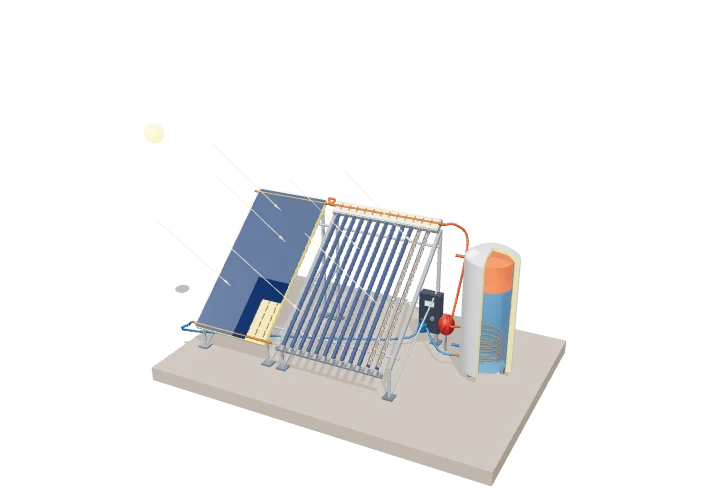 Open the interactive 3D model →
How can a box of glass and copper on a roof heat a tank of water to 60 °C on a cold spring day?
A solar thermal collector is a dark plate under glass that soaks up sunlight and turns it into heat. A liquid flowing through pipes on the plate carries that heat down to a hot-water tank. The clever part is not catching the heat but stopping it from leaking away again.
Solar thermal collectors convert sunlight directly into heat in a fluid, using a dark selective absorber and insulation (glazing and mineral wool in a flat plate, a vacuum in an evacuated tube) to keep that heat from escaping. Their efficiency falls as the collector runs hotter relative to the air and as sunlight weakens, which is why flat plates suit warm climates and low temperatures, while evacuated tubes perform better in cold, cloudy weather or at higher temperatures.
Key facts
- Peak irradiance
- ≈ 1,000 W/m² at the ground in clear sunshine
- Optical efficiency η₀
- Flat plate ≈ 0.75–0.82; evacuated tube ≈ 0.60–0.75
- Heat-loss coefficient a₁
- Flat plate ≈ 3–4.5 W m⁻² K⁻¹; evacuated tube ≈ 1–1.8 W m⁻² K⁻¹
- Selective coating
- Solar absorptance ≈ 0.95, thermal emittance ≈ 0.05
- Domestic system
- ≈ 3–6 m² collector with a 200–300 L tank
- Solar fraction
- ≈ 50–70% of annual hot water in mid-latitude climates
Parts you can explore (12)
- Flat-plate glazing
- Flat-plate absorber and risers
- Flat-plate frame and insulation
- Evacuated tubes
- Heat pipes
- Manifold
- Storage tank
- Heat exchanger coil
- Pump station and controller
- Pipework
- Roof and mounting frame
- Sunlight
In the 3D model
Rotate and take apart the model, follow a guided tour of what each part does and why it’s needed, change it with a live slider, and test yourself with a short quiz. Free, no sign-up.
Open Solar thermal collectors in 3D →
OpenArc Models’ models are simplified teaching schematics. Terms · Privacy