Astronomy & space
Solar system
Astronomy · Planetary system
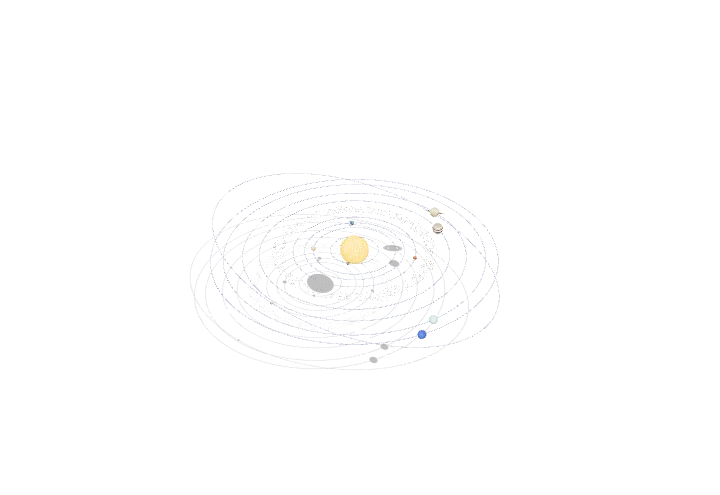 Open the interactive 3D model →
Why does Mercury race round the Sun in 88 days while Neptune takes 165 years?
The Solar System is the Sun and everything its gravity holds on to: eight planets, their moons, dwarf planets like Pluto, and belts of rocky and icy bodies. The planets all go round the Sun the same way, and the farther out a planet is, the slower it moves and the longer its year.
The Solar System is the Sun plus everything bound to it by gravity: eight planets, their moons, dwarf planets such as Pluto, the asteroid and Kuiper belts and comets. Their orbits obey Kepler’s laws, which follow from Newton’s inverse-square gravity, so a planet’s period is fixed by its distance from the Sun.
Key facts
- Age
- ≈ 4.57 billion years
- Sun’s share of mass
- ≈ 99.86%
- 1 astronomical unit (AU)
- 149 597 870.7 km (mean Earth–Sun distance)
- Planet distances
- 0.39 AU (Mercury) to 30.1 AU (Neptune)
- Orbital periods
- 88 days (Mercury) to 164.8 years (Neptune)
- Light travel time Sun → Neptune
- ≈ 4.2 hours
Parts you can explore (14)
- Sun
- Mercury
- Venus
- Earth
- Moon
- Mars
- Asteroid belt
- Jupiter
- Saturn
- Saturn's rings
- Uranus
- Neptune
- Pluto
- Orbits
In the 3D model
Rotate and take apart the model, follow a guided tour of what each part does and why it’s needed, change it with a live slider, and test yourself with a short quiz. Free, no sign-up.
OpenArc Models’ models are simplified teaching schematics. Terms · Privacy