Earth & space
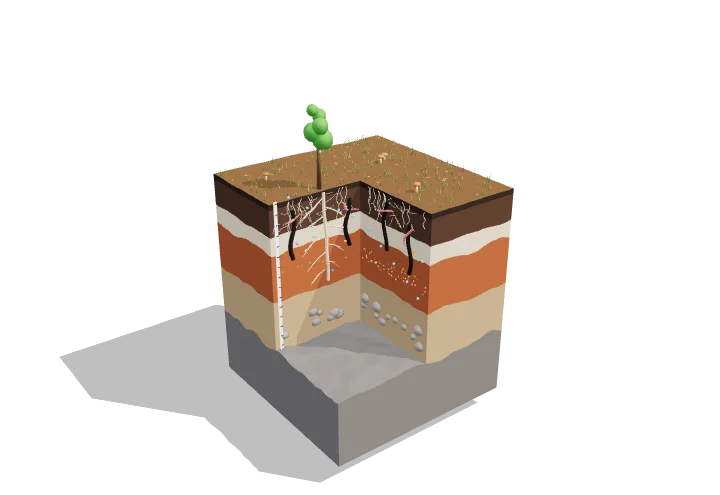
Soil profile
Earth science · Pedology
 Open the interactive 3D model →
If you dug a hole two metres deep in a forest, why would you find stripes of different colours?
Soil is not just dirt: it is broken-down rock mixed with rotting leaves, water, air and billions of living things. Over thousands of years, rainwater soaking downward carries some materials out of the upper soil and leaves them lower down. That sorting builds layers called horizons, each with its own colour and job.
Soil forms where weathered rock, organic matter, water, air and organisms interact, and over centuries to millennia it differentiates into horizons: an organic O layer, humus-rich A, leached E, accumulating B and weathered C above bedrock. Water moving down the profile is the main sorting agent, so climate — especially rainfall — controls how strongly horizons develop and how fast nutrients are lost.
Key facts
- Typical soil volume
- ≈ 45% mineral, ≈ 5% organic, ≈ 25% water, ≈ 25% air
- Formation rate
- roughly 1 cm per 100–1,000 years
- Soil organic carbon (top 1 m)
- ≈ 1,500 billion tonnes C, more than in the atmosphere
- Plants with mycorrhizae
- ≈ 80–90% of land plant species
- Earthworm densities
- commonly 100–500 per m² in temperate grassland
- Infiltration capacity
- > 30 mm/h for sands, < 5 mm/h for clays
Parts you can explore (13)
- O horizon
- A horizon
- E horizon
- B horizon
- C horizon
- Bedrock (R)
- Surface vegetation
- Plant roots
- Earthworms
- Fungal hyphae
- Water infiltration
- Leached nutrients
- Depth scale
In the 3D model
Rotate and take apart the model, follow a guided tour of what each part does and why it’s needed, change it with a live slider, and test yourself with a short quiz. Free, no sign-up.
OpenArc Models’ models are simplified teaching schematics. Terms · Privacy