Cells & molecules
Sodium–potassium pump
Cell biology · Active transport
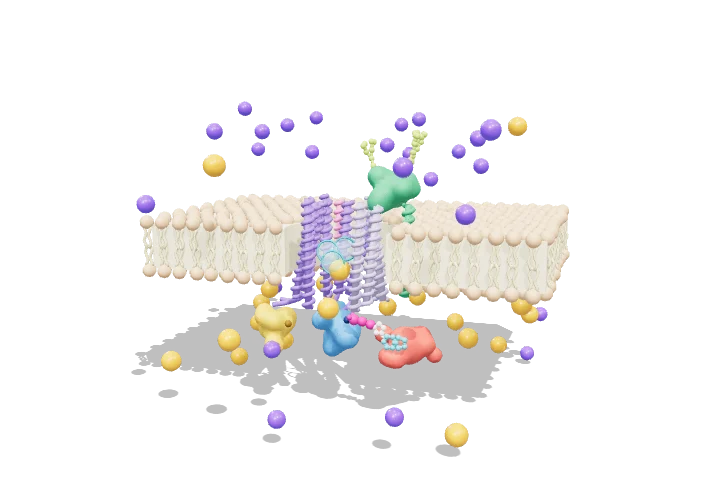 Open the interactive 3D model →
Why does your brain burn so much energy even while you sleep?
Every animal cell keeps lots of sodium outside and lots of potassium inside, but these salts constantly leak back. The sodium–potassium pump is a protein in the cell’s skin that spends one molecule of ATP fuel to throw three sodium out and bring two potassium in. Nerve cells have huge numbers of these pumps, which is a big reason the brain uses so much energy.
The Na⁺/K⁺-ATPase is a P-type pump in the plasma membrane of animal cells that uses the energy of one ATP to move three Na⁺ out and two K⁺ in against their gradients. It works by alternating access: phosphorylation and dephosphorylation switch the protein between inward-facing (E1) and outward-facing (E2) states with different ion affinities.
Key facts
- Stoichiometry
- 3 Na⁺ out : 2 K⁺ in : 1 ATP
- Turnover
- ≈ 100 cycles/s per pump at 37 °C (order of magnitude)
- Subunits
- α (~110 kDa, 10 TM helices), β (~55 kDa glycoprotein), FXYD
- Gradients maintained
- Na⁺ ≈ 145 mM out / 12 mM in; K⁺ ≈ 4 mM out / 140 mM in
- Energy budget
- ≈ 20–30% of resting ATP use in humans; up to ~50–70% in brain
- Net charge per cycle
- +1 out (electrogenic)
Parts you can explore (12)
- Lipid bilayer
- Transmembrane domain (α)
- Phosphorylation (P) domain
- Nucleotide-binding (N) domain
- Actuator (A) domain
- β subunit
- FXYD (γ) subunit
- Ion-binding sites
- Na⁺ ions
- K⁺ ions
- ATP
- Phosphate
In the 3D model
Rotate and take apart the model, follow a guided tour of what each part does and why it’s needed, change it with a live slider, and test yourself with a short quiz. Free, no sign-up.
Open Sodium–potassium pump in 3D →
OpenArc Models’ models are simplified teaching schematics. Terms · Privacy