Chemistry
Soap & detergent micelles
Physical chemistry · Surfactants & colloids
 Open the interactive 3D model →
Oil and water don’t mix — so how does a squirt of soap wash grease off a greasy pan?
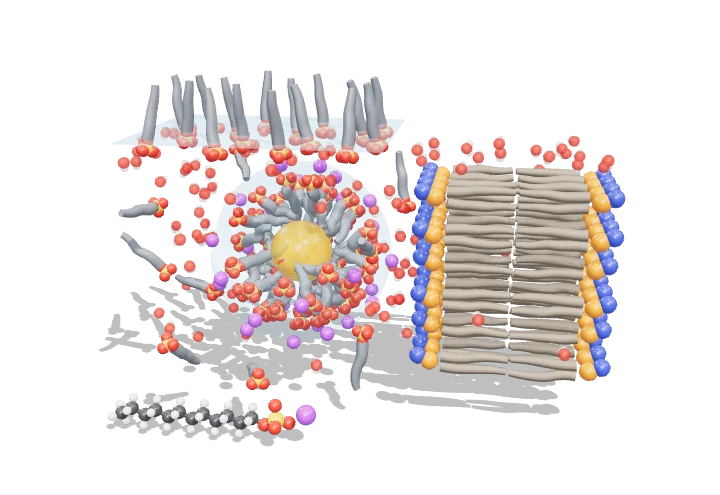
A soap molecule has two ends: a head that loves water and a long oily tail that avoids it. When there is enough soap, the molecules huddle into tiny balls called micelles, with their tails hidden inside and their heads facing the water. Grease dissolves in the oily middle and gets rinsed away.
Surfactants are amphiphilic molecules that first adsorb at surfaces and then, above a critical micelle concentration, self-assemble into micelles whose hydrocarbon cores are shielded from water by a shell of polar heads. The geometry of the molecule decides whether it forms spherical micelles, rods or bilayers, and the oily core is what lets soaps and detergents carry grease away.
Key facts
- CMC of SDS (25 °C)
- ≈ 8.2 mM (≈ 2.4 g L⁻¹)
- Aggregation number of SDS
- ≈ 60–70 molecules per micelle
- SDS micelle radius
- ≈ 2 nm (core ≈ 1.7 nm)
- Surface tension at CMC
- ≈ 38–40 mN m⁻¹ (pure water 72 mN m⁻¹)
- Bound counter-ions
- ≈ 60–70 % of Na⁺ (degree of ionisation α ≈ 0.3)
- Lipid bilayer thickness
- ≈ 4–5 nm head to head
Parts you can explore (10)
- Surfactant molecule (SDS)
- Polar head groups
- Hydrophobic tails
- Trapped oil droplet
- Na⁺ counter-ions
- Stern layer
- Free monomers
- Air–water monolayer
- Bilayer patch
- Water molecules
In the 3D model
Rotate and take apart the model, follow a guided tour of what each part does and why it’s needed, change it with a live slider, and test yourself with a short quiz. Free, no sign-up.
Open Soap & detergent micelles in 3D →
OpenArc Models’ models are simplified teaching schematics. Terms · Privacy