Plants & animals
Garden snail
Zoology · Gastropod mollusc
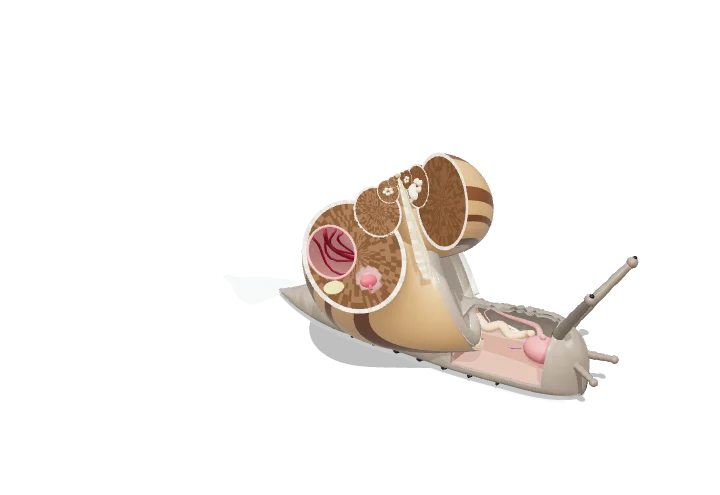 Open the interactive 3D model →
How can a snail climb straight up a window on one foot and a trail of slime?
A garden snail carries its body coiled inside a spiral shell that grows only at its opening. It breathes air with a simple lung, scrapes food with a tongue covered in tiny teeth, and crawls on one big muscular foot. Its slime is clever: it grips like glue where the foot is still and flows like a liquid where a muscle wave pushes it.
The garden snail is an air-breathing land gastropod: its body is twisted into a coiled visceral mass inside a spiral shell, it breathes through a lung formed from the mantle cavity, and each individual is both male and female. It crawls by sending muscular waves along a single flat foot that glides on mucus, which acts alternately as glue and lubricant.
Key facts
- Species
- Cornu aspersum (formerly Helix aspersa), family Helicidae
- Adult shell
- ≈ 25–40 mm wide, 4–5 whorls, dextral (right-handed)
- Crawling speed
- ≈ 1–3 mm/s (a few metres per hour)
- Respiration
- Air-breathing lung (pallial cavity) with a pneumostome
- Reproduction
- Simultaneous hermaphrodite; reciprocal mating, eggs laid in soil
- Lifespan
- Typically 2–5 years in the wild
Parts you can explore (14)
- Shell
- Aperture lip
- Columella
- Digestive gland
- Lung (pallial cavity)
- Mantle collar
- Heart
- Kidney
- Foot
- Pedal waves
- Mucus trail
- Tentacles & eyes
- Radula
- Reproductive system
In the 3D model
Rotate and take apart the model, follow a guided tour of what each part does and why it’s needed, change it with a live slider, and test yourself with a short quiz. Free, no sign-up.
OpenArc Models’ models are simplified teaching schematics. Terms · Privacy