Chemistry
SN2 reaction
Organic chemistry · Reaction mechanism
 Open the interactive 3D model →
Can a molecule really turn itself inside out, like an umbrella in a gust of wind?
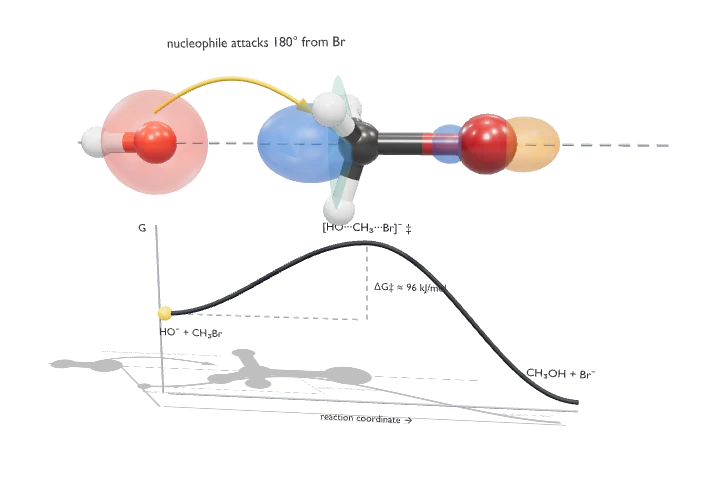
In this reaction a hydroxide ion swaps places with a bromine atom on a carbon. It must push in from the side exactly opposite the bromine, and as the bromine is shoved out, the three hydrogens on the carbon flip to the other side. Everything happens in one smooth step.
In an SN2 reaction a nucleophile bonds to carbon from the side opposite the leaving group while the old bond breaks, all in a single concerted step through a trigonal-bipyramidal transition state. Because the three other groups are pushed through a plane, the carbon’s configuration inverts (Walden inversion) and the rate depends on both the substrate and the nucleophile.
Key facts
- Rate law
- rate = k[CH₃Br][HO⁻] (second order)
- Steps / intermediates
- One step, no intermediate
- Transition state
- Trigonal bipyramid; Nu···C···LG ≈ 180°
- k for HO⁻ + CH₃Br (water, 25 °C)
- ≈ 10⁻⁴ M⁻¹ s⁻¹
- ΔG‡ (water)
- ≈ 96 kJ/mol (from the Eyring equation)
- Stereochemistry
- Inversion of configuration at carbon
Parts you can explore (11)
- Hydroxide nucleophile
- Central carbon
- Hydrogen umbrella
- Bromine leaving group
- Forming C–O bond
- Breaking C–Br bond
- Walden inversion umbrella
- Negative charge (δ−)
- C–Br σ* orbital
- Backside attack trajectory
- Energy profile
In the 3D model
Rotate and take apart the model, follow a guided tour of what each part does and why it’s needed, change it with a live slider, and test yourself with a short quiz. Free, no sign-up.
OpenArc Models’ models are simplified teaching schematics. Terms · Privacy