Electromagnetism & electronics
Smartphone teardown
Electronics · Consumer devices
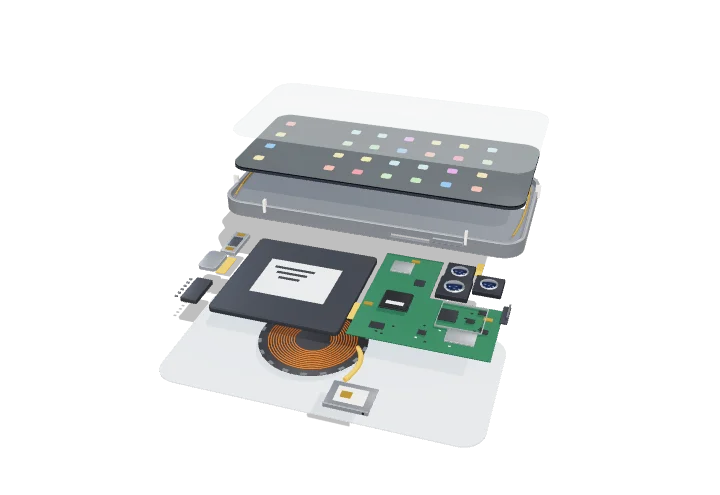 Open the interactive 3D model →
How do a computer, a radio station, a camera and a battery all fit inside a slab under 1 cm thick?
A smartphone is a sandwich: glass on the front, glass on the back, and a metal frame around the edge. Squeezed in between are a big flat battery, a tiny crowded circuit board with the phone’s “brain” chip, several cameras and speakers. Even the metal edge has a job — it doubles as the antenna that talks to cell towers.
A smartphone packs a computer, a radio system, a high-resolution display, several cameras and a battery into a glass-and-metal case under 1 cm thick. Taking it apart layer by layer shows how each subsystem uses a different piece of physics: OLED electroluminescence, CMOS transistors, radio antennas, electrochemistry and magnetic induction.
Key facts
- Typical size and mass
- ≈ 147 × 72 × 7.8 mm; ≈ 170–230 g
- Battery
- ≈ 3,000–5,000 mAh at 3.85 V (≈ 12–19 Wh)
- SoC transistor count
- ≈ 10¹⁰ (Apple A17 Pro, 2023: 19 billion)
- Display pixel density
- ≈ 400–550 pixels per inch
- Wireless charging frequency (Qi)
- ≈ 100–205 kHz
- Antennas
- Typically 10 or more (cellular, Wi-Fi, Bluetooth, GNSS, NFC, UWB)
Parts you can explore (14)
- Cover glass
- OLED display
- Frame and midplate
- Antennas
- Logic board
- System-on-chip (SoC)
- Modem and RF
- Battery
- Camera modules
- Speakers
- Haptic motor
- SIM tray
- Wireless charging coil
- Back glass
In the 3D model
Rotate and take apart the model, follow a guided tour of what each part does and why it’s needed, change it with a live slider, and test yourself with a short quiz. Free, no sign-up.
Open Smartphone teardown in 3D →
OpenArc Models’ models are simplified teaching schematics. Terms · Privacy