Human body
Skin
Anatomy · Integumentary system
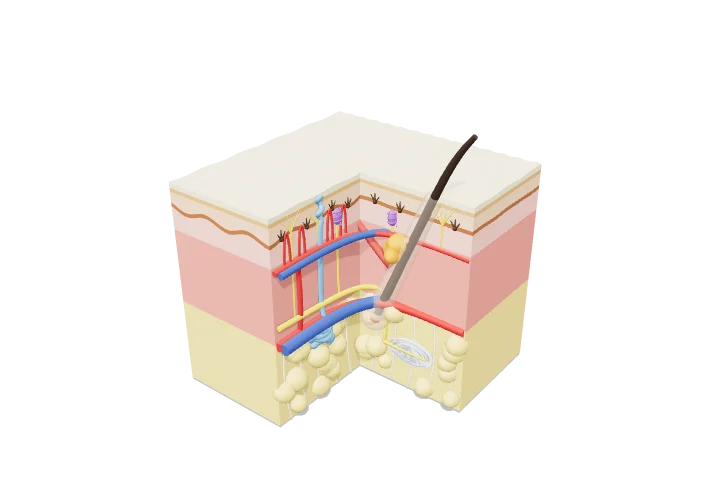 Open the interactive 3D model →
Why do you sweat when you are hot and get goose bumps when you are cold?
Your skin is your largest organ: a waterproof wall on the outside, a tough, stretchy layer underneath, and a cushion of fat below that. It also works as your body’s thermostat, sweating and sending more blood to the surface to lose heat, and squeezing vessels shut to keep heat in. It is packed with sensors for touch, vibration, heat and pain.
Skin is a layered organ: a self-renewing keratinised epidermis sits on a vascular, collagen-rich dermis, which rests on the fatty hypodermis. Its appendages, vessels and receptors make it a barrier, a thermoregulator and a sense organ, adjusting sweat, blood flow and hair position to keep core temperature near 37 °C.
Key facts
- Area (adult)
- ≈ 1.5–2 m²
- Mass
- ≈ 4–5 kg excluding hypodermis (≈ 7% of body mass)
- Epidermal thickness
- ≈ 0.05–0.1 mm (thin skin) to ≈ 1.5 mm (palms, soles)
- Dermal thickness
- ≈ 1–4 mm
- Epidermal turnover
- ≈ 4 weeks from basal layer to shedding
- Eccrine sweat glands
- ≈ 2–4 million; up to ≈ 1–2 L/h of sweat in heat
Parts you can explore (16)
- Stratum corneum
- Stratum granulosum
- Stratum spinosum
- Stratum basale
- Papillary dermis
- Reticular dermis
- Hypodermis
- Hair follicle
- Sebaceous gland
- Arrector pili
- Sweat gland & duct
- Blood vessels
- Melanocytes
- Meissner corpuscles
- Pacinian corpuscle
- Free nerve endings
In the 3D model
Rotate and take apart the model, follow a guided tour of what each part does and why it’s needed, change it with a live slider, and test yourself with a short quiz. Free, no sign-up.
OpenArc Models’ models are simplified teaching schematics. Terms · Privacy