Physics
Simple pendulum
Physics · Oscillation
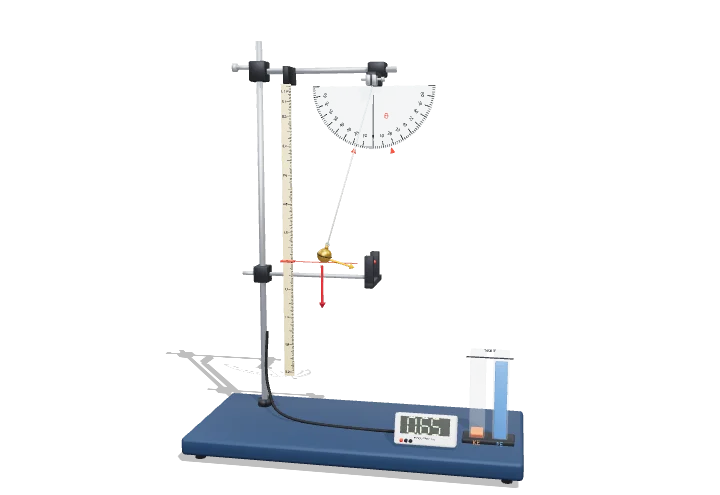 Open the interactive 3D model →
Why does a long pendulum swing slowly and a short one quickly — and does a heavier bob change the beat?
A pendulum is a weight on a string that swings back and forth under gravity. How long each swing takes depends almost only on the length of the string: a longer string swings more slowly. Surprisingly, a heavier weight or a slightly bigger swing makes almost no difference.
A simple pendulum is a point mass on a light string whose restoring torque, −mgL sin θ, gives approximately simple harmonic motion for small swings, with period T = 2π√(L/g) independent of mass and amplitude. At larger amplitudes the period grows (by 0.55% at the model’s 17°, 18% at 90°), and energy continually exchanges between kinetic and gravitational potential forms.
Key facts
- Small-angle period
- T₀ = 2π√(L/g)
- Model period range
- 1.42 s (L = 0.5 m) to 2.84 s (L = 2 m)
- Model default
- L = 1.20 m → T₀ = 2.20 s; A = 17°
- Seconds pendulum (T = 2 s)
- L ≈ 0.994 m at g = 9.81 m/s²
- Period increase at 17° / 90°
- +0.55% / +18.0%
- Local g variation
- 9.780 (equator) to 9.832 m/s² (poles)
Parts you can explore (9)
- Support frame
- Pivot
- String
- Bob
- Protractor scale
- Length scale
- Timer
- Energy bars
- Gravity vector
In the 3D model
Rotate and take apart the model, follow a guided tour of what each part does and why it’s needed, change it with a live slider, and test yourself with a short quiz. Free, no sign-up.
OpenArc Models’ models are simplified teaching schematics. Terms · Privacy