Human body
Shoulder joint
Anatomy · Ball-and-socket joint
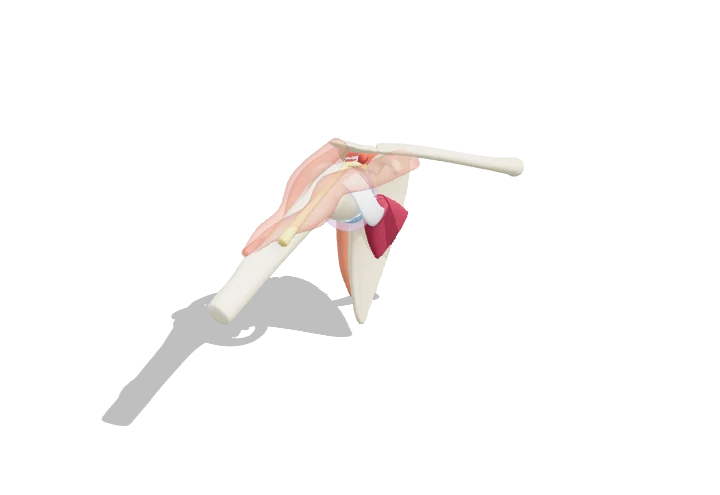 Open the interactive 3D model →
Why can you swing your arm in a full circle but not your leg?
Your shoulder is a ball-and-socket joint, but the socket is very shallow — like a golf ball sitting on a tee. That lets your arm move further than any other joint, but it also makes the shoulder the joint that dislocates most often. Four small muscles, the rotator cuff, wrap around the ball to hold it in place.
The glenohumeral joint is a ball-and-socket joint in which a large humeral head sits on a small, shallow glenoid, giving the greatest range of motion of any joint in the body at the cost of stability. Stability comes mostly from soft tissue — the labrum, the capsule and its ligaments, and above all the rotator cuff — while elevation of the arm is shared between the glenohumeral joint and rotation of the scapula in a ratio of about 2 : 1.
Key facts
- Joint type
- Synovial ball-and-socket, 3 rotational degrees of freedom
- Humeral head
- ≈ 45–50 mm diameter, ≈ 130–135° neck–shaft angle, ≈ 20–30° retroversion
- Glenoid
- ≈ 35 mm tall × 25 mm wide; covers about a quarter to a third of the head
- Arm elevation
- ≈ 180° total ≈ 120° glenohumeral + 60° scapulothoracic
- Rotator cuff
- 4 muscles: supraspinatus, infraspinatus, teres minor, subscapularis (SITS)
- Dislocations
- Most often dislocated large joint; ≈ 95% anterior
Parts you can explore (12)
- Scapula
- Clavicle
- Humerus
- Articular cartilage
- Glenoid labrum
- Joint capsule
- Supraspinatus
- Infraspinatus
- Teres minor
- Subscapularis
- Deltoid
- Biceps tendon (long head)
In the 3D model
Rotate and take apart the model, follow a guided tour of what each part does and why it’s needed, change it with a live slider, and test yourself with a short quiz. Free, no sign-up.
OpenArc Models’ models are simplified teaching schematics. Terms · Privacy