Plants & animals
Shark anatomy
Fishes · Chondrichthyes
 Open the interactive 3D model →
How does a shark float without a swim bladder and find prey it cannot even see?
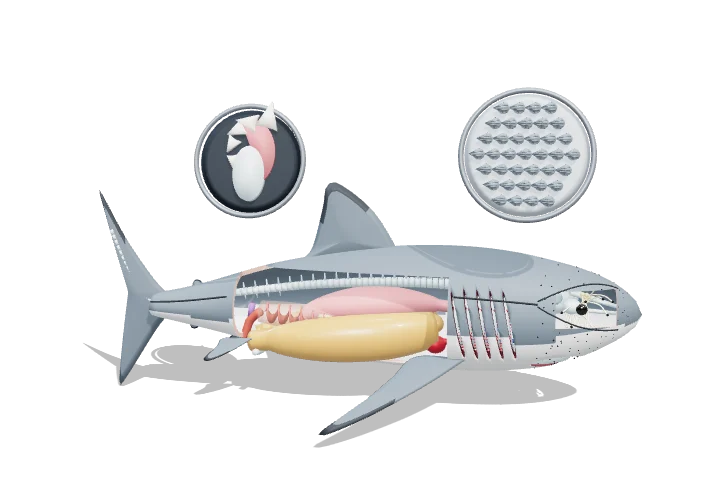
A shark is a fish with a skeleton made of bendy cartilage instead of bone. It stays afloat thanks to a huge liver full of light oil, and it breathes by pushing water through five gill slits on each side. It hunts with senses we lack, including tiny pores on its snout that feel the electricity of a prey animal’s muscles.
Sharks are cartilaginous fishes with a flexible cartilage skeleton, five to seven pairs of gill slits, an oil-filled liver for buoyancy and a spiral-valve intestine. They sense prey with electroreceptive ampullae of Lorenzini and a lateral line, and their skin scales and teeth are built from the same tooth-like tissue.
Key facts
- Species modelled
- Great white shark, Carcharodon carcharias
- Length
- typically 4–5 m; large females ≈ 6 m
- Liver
- up to ≈ 20–25% of body mass in large sharks
- Gill slits
- 5 pairs (6–7 in a few species)
- Teeth in the jaws
- ≈ 300 at a time, in several rows; replaced continuously
- Electrosensitivity
- down to ≈ 5 nV/cm in sharks and rays
Parts you can explore (11)
- Skin and fins
- Cartilaginous skeleton
- Gill slits and gills
- Liver
- Heart
- Stomach
- Spiral-valve intestine
- Ampullae of Lorenzini
- Lateral line
- Dermal denticles
- Teeth
In the 3D model
Rotate and take apart the model, follow a guided tour of what each part does and why it’s needed, change it with a live slider, and test yourself with a short quiz. Free, no sign-up.
OpenArc Models’ models are simplified teaching schematics. Terms · Privacy