Mechanisms
Lockstitch sewing machine
Mechanisms · Machines
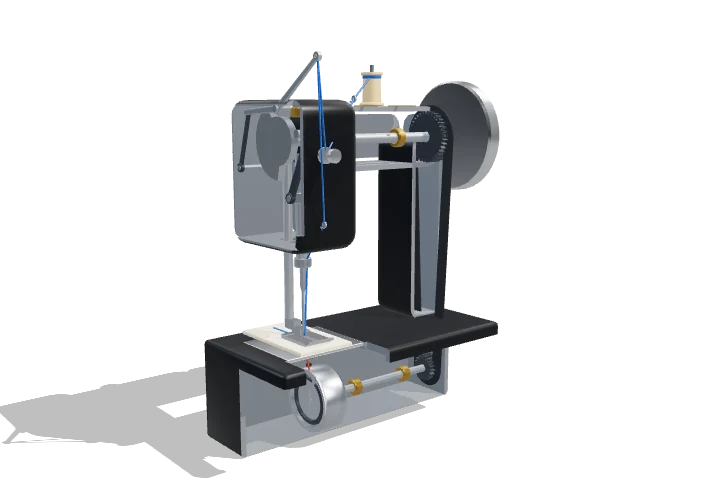 Open the interactive 3D model →
How can a needle sew a seam from above when it never goes all the way through the cloth?
A sewing machine uses two threads, one from above and one from a small bobbin underneath. The needle pokes a loop of the top thread through the cloth, and a spinning hook below grabs that loop and wraps it right round the bobbin. Then the loop is pulled tight, so the two threads lock together in the middle of the fabric.
A lockstitch sewing machine joins fabric by interlocking two threads — the upper (needle) thread and the lower (bobbin) thread — inside the cloth, one stitch per revolution of the arm shaft. A slider-crank drives the needle, a four-bar take-up lever manages the upper thread, a rotary hook turning at twice shaft speed passes the needle loop round the bobbin, and a four-motion feed advances the fabric, all locked together in time by shafts and a toothed belt.
Key facts
- Stitch type
- Lockstitch, ISO 4915 class 301
- Model needle stroke
- 33 mm (slider-crank: 16.4 mm crank, 36 mm link)
- Hook speed
- 2 × arm-shaft speed (two hook turns per stitch)
- Model stitch length
- 4 mm (typical range 1–5 mm)
- Industrial speed
- up to ≈ 5000 stitches/min; domestic ≈ 800–1100
- Feed travel
- only while the needle is out of the cloth
Parts you can explore (15)
- Arm and bed
- Hand wheel and arm shaft
- Needle bar crank
- Needle bar and needle
- Take-up lever
- Thread tension and spool
- Presser foot
- Needle plate
- Feed dogs
- Rotary hook
- Bobbin and bobbin case
- Hook drive
- Needle thread
- Bobbin thread
- Fabric
In the 3D model
Rotate and take apart the model, follow a guided tour of what each part does and why it’s needed, change it with a live slider, and test yourself with a short quiz. Free, no sign-up.
Open Lockstitch sewing machine in 3D →
OpenArc Models’ models are simplified teaching schematics. Terms · Privacy