Plants & animals
Seed germination
Plant biology · Development
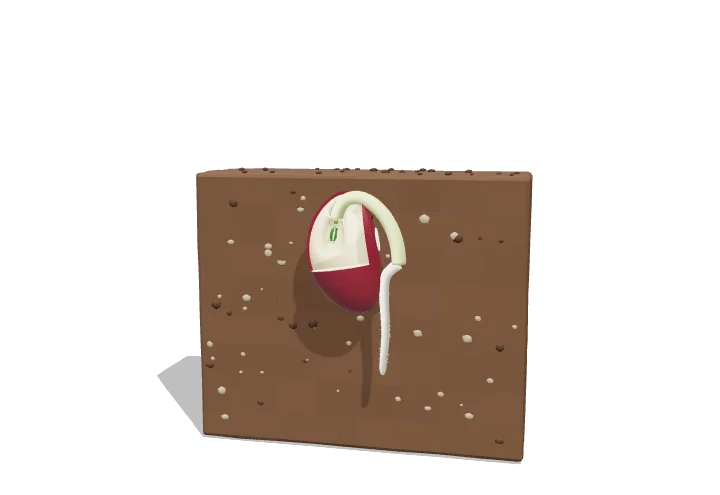 Open the interactive 3D model →
How does a hard, dry bean know when to wake up and grow into a plant?
A bean seed is a tiny baby plant packed in a coat with its own lunchbox of food. When it soaks up water it wakes up, sends a root down first, and then pushes a shoot up into the light. Once its first green leaves can make food from sunlight, it no longer needs the packed lunch.
A bean seed is a dormant embryo plant wrapped in a protective coat and supplied with food stored in two large cotyledons. Germination begins with water uptake (imbibition) and ends when the radicle breaks through the coat; then the hypocotyl hook lifts the cotyledons above ground and the first true leaves take over food production.
Key facts
- Species modelled
- Common bean, Phaseolus vulgaris (a eudicot)
- Type of emergence
- Epigeal: cotyledons carried above ground
- Water content of a dry seed
- ≈ 10–15% of fresh mass
- Radicle emergence
- ≈ 2–4 days after sowing in warm, moist soil
- Soil temperature for bean
- minimum ≈ 10 °C; optimum ≈ 20–30 °C
- Seed reserves (bean)
- mostly starch; ≈ 20–25% protein by dry mass
Parts you can explore (10)
- Seed coat
- Hilum
- Micropyle
- Cotyledons
- Radicle
- Hypocotyl
- Epicotyl
- Plumule
- Lateral roots and root hairs
- Soil
In the 3D model
Rotate and take apart the model, follow a guided tour of what each part does and why it’s needed, change it with a live slider, and test yourself with a short quiz. Free, no sign-up.
OpenArc Models’ models are simplified teaching schematics. Terms · Privacy