Astronomy & space
Seasons
Astronomy · Earth’s orbit and tilt
 Open the interactive 3D model →
If Earth is closest to the Sun in January, why is January cold in Europe and North America?
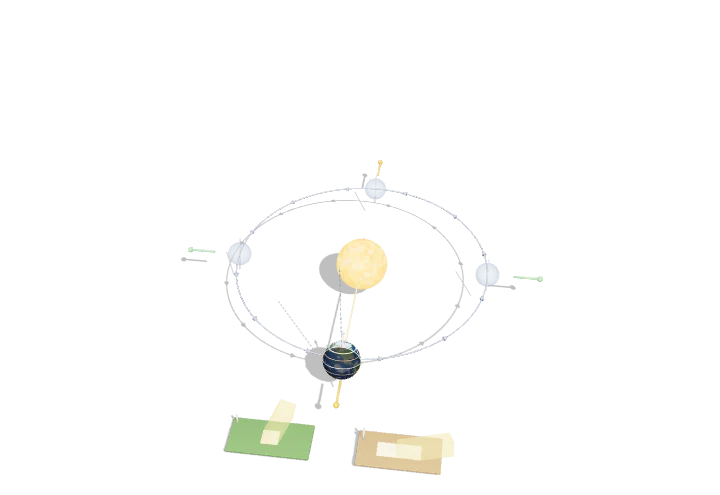
Earth spins on a tilted axis, and that tilt always points the same way in space as we travel around the Sun. For half the year your half of the planet leans towards the Sun: the Sun climbs higher and days are longer, so it is summer. Half a year later your half leans away, and it is winter.
Earth’s rotation axis is tilted 23.44° to the perpendicular of its orbit and keeps pointing in the same direction in space, so over a year each hemisphere alternately leans toward and away from the Sun. The hemisphere tilted sunward has a higher noon Sun, which concentrates sunlight, and longer days — together these, not the small change in Sun–Earth distance, cause the seasons.
Key facts
- Axial tilt (obliquity)
- 23.44°
- Solar declination range
- −23.44° to +23.44°
- Sun–Earth distance
- 0.983 AU (early Jan) to 1.017 AU (early Jul)
- Day length at 45° N
- ≈ 8 h 46 min (Dec) to ≈ 15 h 37 min (Jun)
- Noon Sun at 45° N
- 21.6° (Dec solstice) to 68.4° (Jun solstice)
- Tropical year
- 365.242 days
Parts you can explore (12)
- Sun
- Earth's orbit
- Earth
- Axial tilt
- Equator
- Tropics
- Polar circles
- Latitude 45° N
- Terminator
- Direct sunlight
- Solstices and equinoxes
- Sunlight angle patches
In the 3D model
Rotate and take apart the model, follow a guided tour of what each part does and why it’s needed, change it with a live slider, and test yourself with a short quiz. Free, no sign-up.
OpenArc Models’ models are simplified teaching schematics. Terms · Privacy