Mechanisms
Scotch yoke
Mechanisms · Rotary to linear
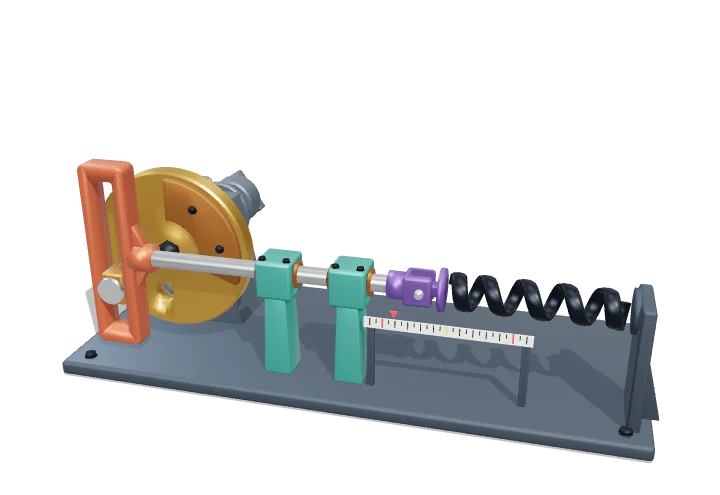 Open the interactive 3D model →
How can a wheel turning at a steady speed make something slide back and forth in a perfect wave?
A pin sticks out of a turning disc and sits in a slot cut in a frame called a yoke. The slot lets the pin slide up and down freely, so only its side-to-side movement pushes the yoke. The yoke and its rod therefore swing back and forth in a perfectly smooth rhythm.
A Scotch yoke converts steady rotation into reciprocating motion by letting a crank pin slide in a slot perpendicular to the output stroke. Because only the pin’s horizontal coordinate reaches the yoke, the output is exact simple harmonic motion, x = r cos θ — the limiting case of a slider-crank with an infinitely long connecting rod.
Key facts
- Output motion
- x = r cos θ (pure simple harmonic)
- Model crank radius / stroke
- r = 50 mm, stroke 2r = 100 mm
- Peak velocity / acceleration
- rω at mid-stroke / rω² at the ends
- Harmonic content
- Only the fundamental (no 2ω term)
- Speed range (model)
- 10–300 rpm (motion shown slowed 6×)
- Typical yoke-actuator rotation
- 90° (quarter-turn valves)
Parts you can explore (12)
- Crank disc
- Crank pin & slider block
- Slotted yoke
- Output rod
- Guide bushings
- Drive shaft
- Main bearing housing
- Base frame
- Counterweight
- Rod end clevis
- Load spring
- Stroke scale
In the 3D model
Rotate and take apart the model, follow a guided tour of what each part does and why it’s needed, change it with a live slider, and test yourself with a short quiz. Free, no sign-up.
OpenArc Models’ models are simplified teaching schematics. Terms · Privacy