Mechanisms
Scissor jack
Machines · Screws and linkages
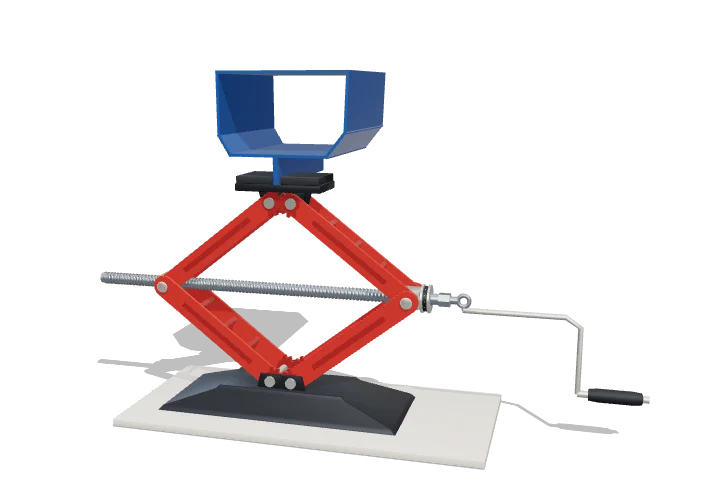 Open the interactive 3D model →
How can one person lift the corner of a one-tonne car with a small hand crank?
A scissor jack trades distance for force. You turn the crank many times, and a screw slowly pulls two hinged corners of a diamond of steel arms together, which pushes the top of the diamond up. Your hand moves a long way with little force, and the car moves a short way with a large force.
A scissor jack chains two simple machines: a lead screw that turns hand rotation into a strong, slow straight pull, and a rhombus linkage that turns that horizontal pull into vertical lift. Its mechanical advantage changes with the arm angle, being largest when the jack is extended and smallest when it is nearly flat.
Key facts
- Model screw
- Ø14 mm, 2 mm lead, 90 mm crank radius
- Arm length (pivot to pivot)
- 160 mm
- Lift range (model)
- ≈ 13 cm to 35 cm over 80 crank turns
- Screw-only ideal ratio
- 2π × 90 mm ÷ 2 mm ≈ 283
- Screw tension at θ = 12°
- ≈ 4.7 × load
- Typical rating, car jack
- ≈ 0.8–1.5 t (one corner)
Parts you can explore (12)
- Base
- Lower arms
- Upper arms
- Gear segments
- Threaded trunnion (nut)
- Plain trunnion
- Lead screw
- Thrust bearing
- Crank handle
- Saddle
- Pivot pins
- Vehicle sill (load)
In the 3D model
Rotate and take apart the model, follow a guided tour of what each part does and why it’s needed, change it with a live slider, and test yourself with a short quiz. Free, no sign-up.
OpenArc Models’ models are simplified teaching schematics. Terms · Privacy