Astronomy & space
Saturn V rocket
Spaceflight · Launch vehicle
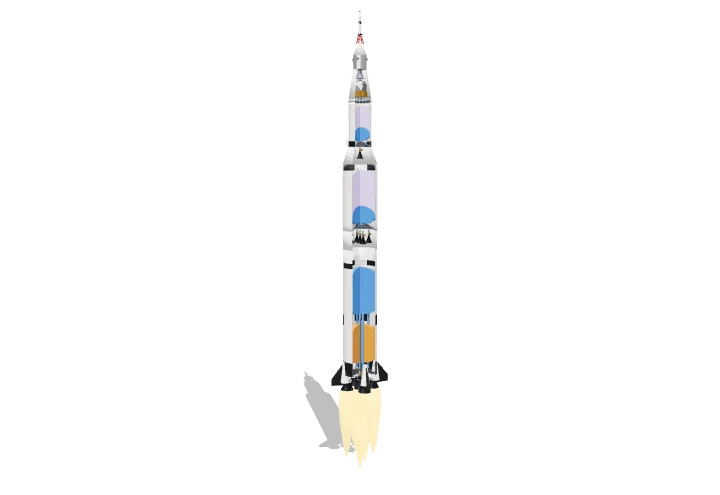 Open the interactive 3D model →
Why did it take a 110-metre rocket, as heavy as a navy destroyer, to send three people to the Moon?
The Saturn V was a stack of three rockets on top of each other, with the Apollo spacecraft at the very top. Each rocket burned until its tanks were empty and then dropped away, so the rest did not have to carry dead weight. Almost all of its 2,900 tonnes was fuel — only about 45 tonnes was the spacecraft headed for the Moon.
The Saturn V was a three-stage, liquid-fuelled launch vehicle that sent Apollo crews to the Moon between 1968 and 1972. Each stage burns until its tanks are empty and is then discarded, so the remaining engines accelerate only useful mass — the rocket equation applied three times in succession.
Key facts
- Height / diameter
- 110.6 m / 10.1 m
- Liftoff mass
- ≈ 2,900–2,970 t (mostly propellant)
- Liftoff thrust
- ≈ 34 MN from five F-1 engines
- Payload
- ≈ 140 t to low Earth orbit; ≈ 45–49 t to trans-lunar injection
- Propellants
- Stage 1 RP-1/LOX; stages 2 and 3 LH₂/LOX
- Flights
- 13 launches, 1967–1973, no payload lost
Parts you can explore (15)
- S-IC first stage
- F-1 engines
- S-IC propellant tanks
- S-II second stage
- S-II propellant tanks
- J-2 engines
- S-IVB third stage
- S-IVB propellant tanks
- Instrument unit
- Spacecraft–LM adapter
- Lunar module
- Service module
- Command module
- Launch escape tower
- Engine exhaust
In the 3D model
Rotate and take apart the model, follow a guided tour of what each part does and why it’s needed, change it with a live slider, and test yourself with a short quiz. Free, no sign-up.
OpenArc Models’ models are simplified teaching schematics. Terms · Privacy