Astronomy & space
Saturn and its rings
Planetary science · Ring systems
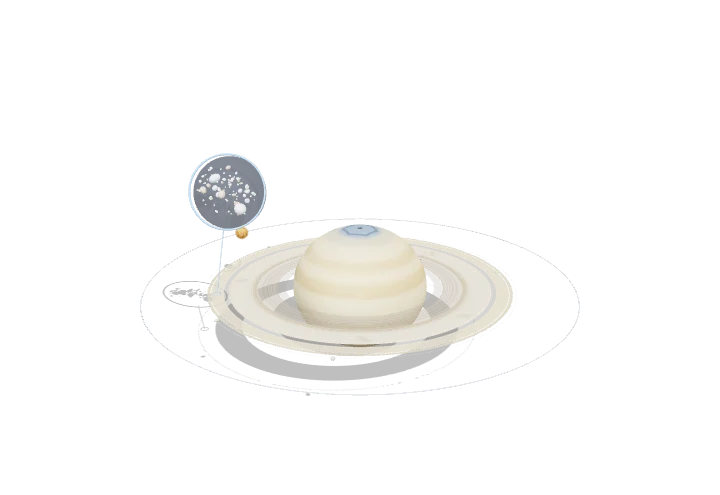 Open the interactive 3D model →
Saturn’s rings are wider than 20 Earths side by side — so why do they almost disappear every 15 years?
Saturn’s rings are not solid: they are billions of chunks of ice, from pebbles to house-sized boulders, each orbiting the planet like a tiny moon. They are hundreds of thousands of kilometres wide but usually only about 10 metres thick. When we see them exactly edge-on, they become almost invisible.
Saturn’s rings are a vast, thin disk of countless water-ice particles, each on its own Keplerian orbit inside the planet’s Roche limit. Their gaps, sharp edges and narrow ringlets are sculpted by gravitational resonances and shepherding by small moons.
Key facts
- Equatorial / polar radius
- 60,268 km / 54,364 km (flattening 0.098)
- Mass and density
- 5.68 × 10²⁶ kg (95 Earth masses); 0.69 g cm⁻³
- Main rings, D to F
- ≈ 67,000–140,200 km from Saturn’s centre
- Ring thickness
- typically ~10 m, up to ~1 km
- Ring mass (Cassini, 2019)
- ≈ 1.5 × 10¹⁹ kg ≈ 0.4 Mimas masses
- Obliquity / year
- 26.7° / 29.5 Earth years
Parts you can explore (12)
- Saturn
- North polar hexagon
- D ring
- C ring
- B ring
- Cassini division
- A ring
- Encke gap
- F ring
- Shepherd moons
- Titan
- Ring particles
In the 3D model
Rotate and take apart the model, follow a guided tour of what each part does and why it’s needed, change it with a live slider, and test yourself with a short quiz. Free, no sign-up.
Open Saturn and its rings in 3D →
OpenArc Models’ models are simplified teaching schematics. Terms · Privacy