Earth & space
Sand dunes
Earth science · Aeolian processes
 Open the interactive 3D model →
How can a hill of sand taller than a house walk across the desert — and why do small dunes outrun big ones?
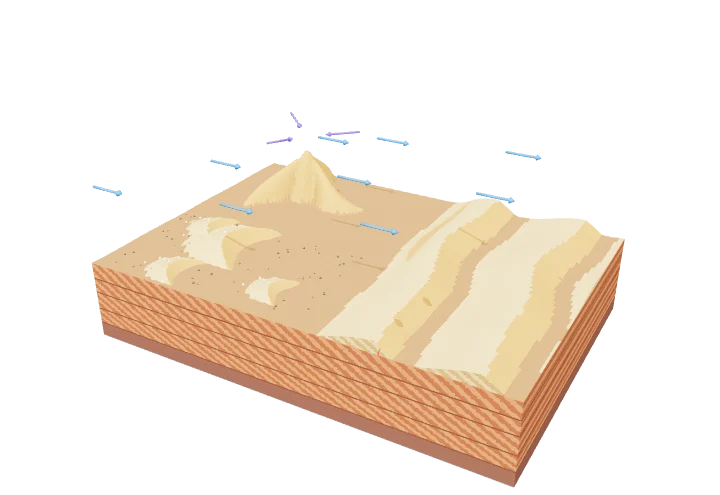
When wind blows hard enough, sand grains start hopping along the ground. They bounce up the gentle side of a dune, pile up at the top and slide down the steep side. Grain by grain, the whole dune creeps downwind, and its shape depends on how much sand there is and which way the wind blows.
Wind moves sand mainly by saltation, carrying grains up the gentle windward (stoss) side of a dune until they accumulate at the brink and avalanche down the steep slip face at the angle of repose. Dune shape depends on sand supply and wind regime: barchans where sand is scarce and the wind steady, transverse ridges where sand is abundant, and star dunes where winds blow from several directions.
Key facts
- Angle of repose (dry sand)
- ≈ 32–34°
- Stoss slopes
- ≈ 5–15°
- Threshold shear velocity
- ≈ 0.2–0.25 m/s for 0.25 mm quartz sand
- Threshold wind speed
- ≈ 5–6 m/s measured a few metres up
- Saltation hop height
- mostly < 0.5 m; hop length ≈ 10× height
- Barchan migration
- ≈ 10–100 m/yr, faster for smaller dunes
Parts you can explore (10)
- Desert floor
- Barchan dunes
- Transverse dunes
- Star dune
- Slip faces
- Wind
- Saltating grains
- Grain-flow avalanches
- Cross-bedded sandstone
- Angle of repose
In the 3D model
Rotate and take apart the model, follow a guided tour of what each part does and why it’s needed, change it with a live slider, and test yourself with a short quiz. Free, no sign-up.
OpenArc Models’ models are simplified teaching schematics. Terms · Privacy