Physics
Rutherford scattering
Atomic & nuclear physics · Experiment
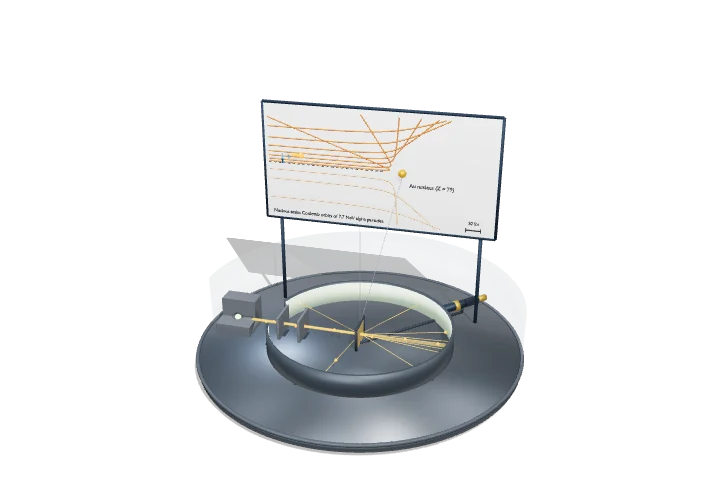 Open the interactive 3D model →
If atoms are mostly empty space, how did anyone find that out by shooting at a sheet of gold?
In 1909 scientists fired tiny, fast, positively charged particles (alpha particles) at gold foil a few hundred times thinner than a human hair. Almost all of them flew straight through, but about 1 in 8000 bounced back. The only explanation was that each atom has a tiny, heavy, positive centre — the nucleus — surrounded by mostly empty space.
In the Geiger–Marsden experiment, alpha particles fired at thin gold foil mostly passed straight through, but about 1 in 8000 was deflected by more than 90°. In 1911 Rutherford showed that this pattern follows exactly from electrical (Coulomb) repulsion by a tiny, massive, positively charged nucleus, overturning the plum-pudding model of the atom.
Key facts
- Alpha energy (RaC′, historical)
- 7.7 MeV
- Head-on closest approach to Au
- d = kZ₁Z₂e²/K ≈ 29.6 fm at 7.7 MeV
- Gold nuclear radius
- ≈ 7 fm (R ≈ 1.2 A^(1/3) fm)
- Gold atom radius
- ≈ 0.14 nm = 140 000 fm
- Foil thickness
- ≈ 0.4 µm (~1000 atomic layers)
- Back-scattered fraction
- ≈ 1 in 8000 beyond 90° (Geiger & Marsden 1909)
Parts you can explore (11)
- Alpha source
- Lead block
- Collimator
- Gold foil
- Zinc sulfide screen
- Alpha trajectories
- Alpha particles
- Scintillations
- Viewing microscope
- Vacuum chamber
- Nucleus-scale inset
In the 3D model
Rotate and take apart the model, follow a guided tour of what each part does and why it’s needed, change it with a live slider, and test yourself with a short quiz. Free, no sign-up.
Open Rutherford scattering in 3D →
OpenArc Models’ models are simplified teaching schematics. Terms · Privacy