Power & energy
Radioisotope thermoelectric generator
Energy conversion · Space power
 Open the interactive 3D model →
How does a Mars rover keep its lights on for years with no solar panels and no moving parts?
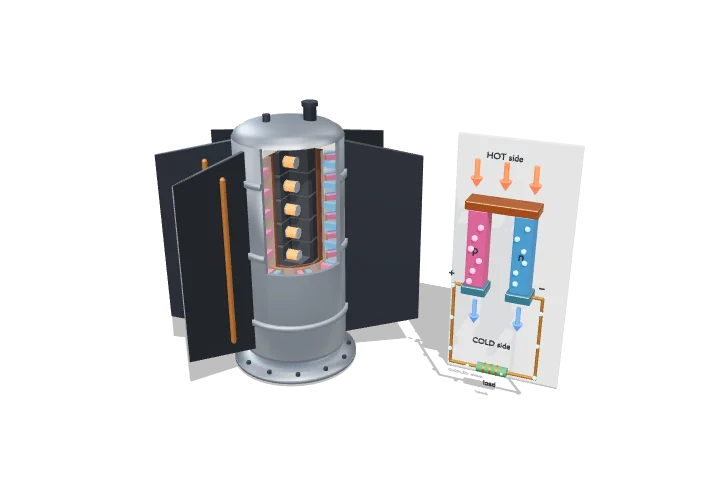
Inside this generator, a few kilograms of radioactive plutonium stay hot for decades as they slowly decay. Special materials turn part of the flow of heat from the hot middle to the cool fins directly into electricity. Nothing spins, burns or needs refuelling.
A radioisotope thermoelectric generator turns the decay heat of plutonium-238 into electricity using thermocouples, with no moving parts. The Multi-Mission RTG on the Curiosity and Perseverance rovers converts about 2 kW of heat into about 110 W of electricity at launch and keeps working for well over a decade.
Key facts
- Fuel
- ≈ 4.8 kg PuO₂ in 8 GPHS modules (32 pellets)
- Heat output at launch
- ≈ 2,000 W(th)
- Electrical output at launch
- ≈ 110 W(e) at ≈ 28 V DC
- Conversion efficiency
- ≈ 6%
- Thermocouples
- 768 (PbTe n-type / TAGS p-type)
- Pu-238 half-life
- 87.7 years
Parts you can explore (11)
- Housing
- Cooling fins
- Coolant tubes
- GPHS modules
- Pu-238 fuel pellets
- Thermal insulation
- Thermocouples
- End caps and mounts
- Seebeck module
- External circuit
- Charge carriers
In the 3D model
Rotate and take apart the model, follow a guided tour of what each part does and why it’s needed, change it with a live slider, and test yourself with a short quiz. Free, no sign-up.
Open Radioisotope thermoelectric generator in 3D →
OpenArc Models’ models are simplified teaching schematics. Terms · Privacy