Fluids & heat
Rotary vane vacuum pump
Vacuum technology · Positive-displacement pump
 Open the interactive 3D model →
How do you get air out of a box when there is nothing left to push it with?
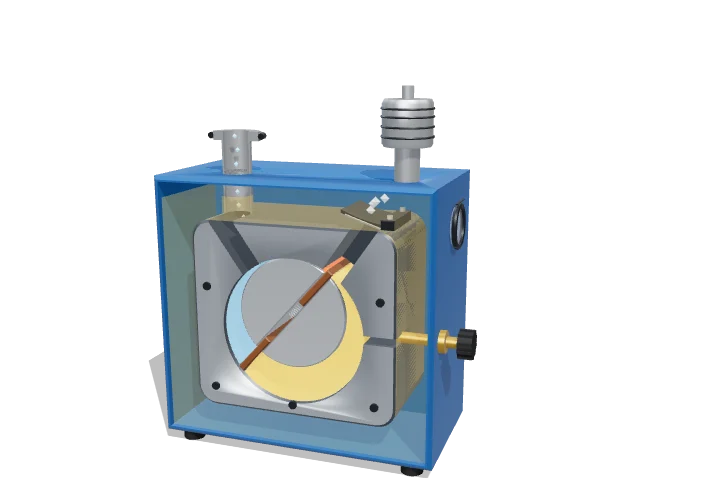
A vacuum pump removes air from a container. Inside this one, a spinning wheel with two sliding blades scoops up pockets of gas, squeezes them and pushes them out into the room. A bath of oil seals the tiny gaps so the gas can’t sneak back.
An oil-sealed rotary vane pump is a positive-displacement vacuum pump: vanes sliding in an off-centre rotor sweep gas from the inlet, trap it, compress it above atmospheric pressure and push it out through an oil-covered flap valve. Its pumping speed is set by swept volume and rotor speed, while its ultimate pressure is limited by leakage, oil vapour and gas dissolved in the oil.
Key facts
- Pumping speed (this model)
- ≈ 16 m³/h at 1450 rpm (geometric, 2 vanes, bore Ø 80 mm × 53 mm)
- Typical sizes
- ≈ 1–600 m³/h
- Ultimate pressure
- ≈ 10⁻² mbar single-stage, ≈ 10⁻³ mbar two-stage (gas ballast closed)
- Operating range
- Atmosphere (1013 mbar) down to ≈ 10⁻³ mbar
- Compression ratio per stage
- Up to ≈ 10⁵
- Rotor speed
- Usually 1450–1750 rpm, direct-coupled to a 50/60 Hz motor
Parts you can explore (13)
- Stator
- Rotor
- Vanes
- Inlet port
- Exhaust valve
- Gas pockets
- Oil reservoir
- Gas ballast valve
- Exhaust outlet
- Drive motor
- Shaft seal and coupling
- Oil sight glass
- Gas flow tracers
In the 3D model
Rotate and take apart the model, follow a guided tour of what each part does and why it’s needed, change it with a live slider, and test yourself with a short quiz. Free, no sign-up.
Open Rotary vane vacuum pump in 3D →
OpenArc Models’ models are simplified teaching schematics. Terms · Privacy