Plants & animals
Root tip
Plant biology · Root anatomy
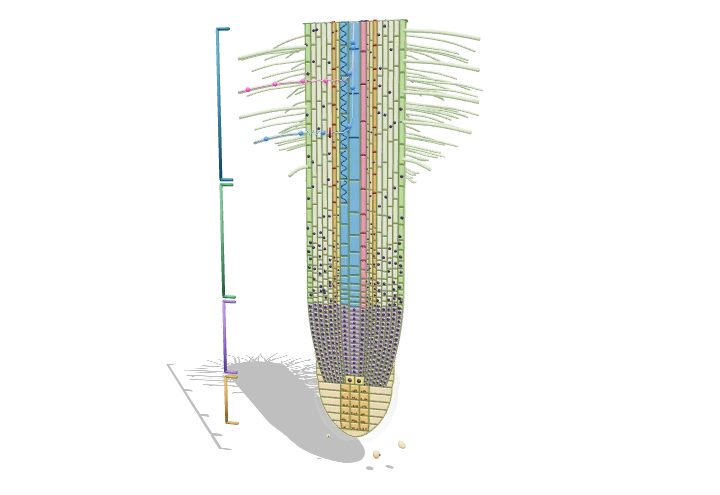 Open the interactive 3D model →
How does a soft root tip push through hard soil and know which way is down?
A root only grows at its very tip. A tough cap protects the tip and senses gravity, cells just behind it divide, and then they stretch like balloons to push the root forward. Further back, thousands of tiny hairs soak up water, which travels inward to pipes that carry it up the plant.
A root grows only at its tip, where a capped meristem makes new cells that then elongate and mature into the tissues of the root. In the maturation zone, root hairs absorb water that crosses the cortex by apoplastic and symplastic routes until the Casparian strip of the endodermis forces it through living membranes into the xylem.
Key facts
- Growth zone
- a few mm behind the tip (≈10 mm in maize primary roots)
- Cell elongation
- cells lengthen roughly 10–20-fold after leaving the meristem
- Root hair size
- ≈ 5–20 µm wide, up to ~1 mm long
- Quiescent centre
- 4 cells in Arabidopsis; hundreds in maize
- Soil water potential
- ≈ −0.03 MPa (field capacity) to −1.5 MPa (permanent wilting point)
- Plasmodesma size limit
- typically < ~1 kDa for free diffusion
Parts you can explore (14)
- Root cap
- Quiescent centre
- Apical meristem
- Zone of elongation
- Zone of maturation
- Epidermis
- Root hairs
- Cortex
- Endodermis
- Casparian strip
- Pericycle
- Xylem
- Phloem
- Water uptake paths
In the 3D model
Rotate and take apart the model, follow a guided tour of what each part does and why it’s needed, change it with a live slider, and test yourself with a short quiz. Free, no sign-up.
OpenArc Models’ models are simplified teaching schematics. Terms · Privacy