Power & energy
Liquid rocket engine
Propulsion · Liquid bipropellant (gas-generator cycle)
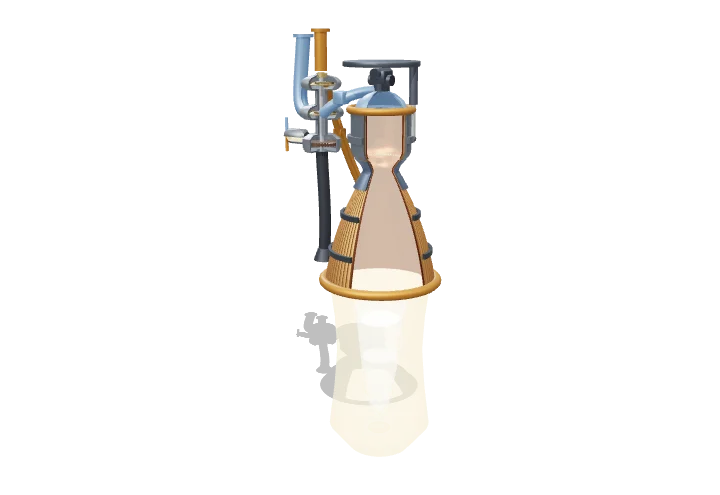 Open the interactive 3D model →
How does a rocket push itself forward in space, where there is nothing to push against?
A rocket engine burns fuel and liquid oxygen together in a small chamber, making extremely hot, high-pressure gas. The gas squeezes through a narrow throat and then speeds up through a bell-shaped nozzle, leaving at about 3 kilometres per second. Throwing all that gas backwards pushes the rocket forwards.
A liquid bipropellant rocket engine pumps fuel and oxidiser at high pressure into a combustion chamber, where they burn to hot, high-pressure gas that chokes at the throat and accelerates supersonically through a bell nozzle. Thrust is the momentum flux of the exhaust plus a pressure term, F = ṁvₑ + (pₑ − pₐ)Aₑ.
Key facts
- Propellants (model)
- RP-1 kerosene + liquid oxygen, mixture ratio ≈ 2.3–2.7
- Cycle
- Gas generator: turbine driven by a small side combustor
- Chamber (model, 100 %)
- p_c ≈ 11 MPa, T_c ≈ 3600 K
- Nozzle (model)
- throat Ø 0.25 m, exit Ø 1.0 m, expansion ratio 16
- Exhaust velocity
- ≈ 3 km/s (kerosene/LOX)
- Thrust (model)
- ≈ 870 kN sea level, ≈ 950 kN vacuum
Parts you can explore (12)
- Gimbal mount
- Oxidiser line
- Fuel line
- Turbopump
- Gas generator
- Turbine exhaust
- Injector plate
- Combustion chamber
- Throat
- Bell nozzle
- Cooling channels
- Exhaust plume
In the 3D model
Rotate and take apart the model, follow a guided tour of what each part does and why it’s needed, change it with a live slider, and test yourself with a short quiz. Free, no sign-up.
Open Liquid rocket engine in 3D →
OpenArc Models’ models are simplified teaching schematics. Terms · Privacy