Earth & space
Rock cycle
Geology · Earth materials
 Open the interactive 3D model →
Could the pebble in your shoe once have been lava, a sea floor or the root of a mountain?
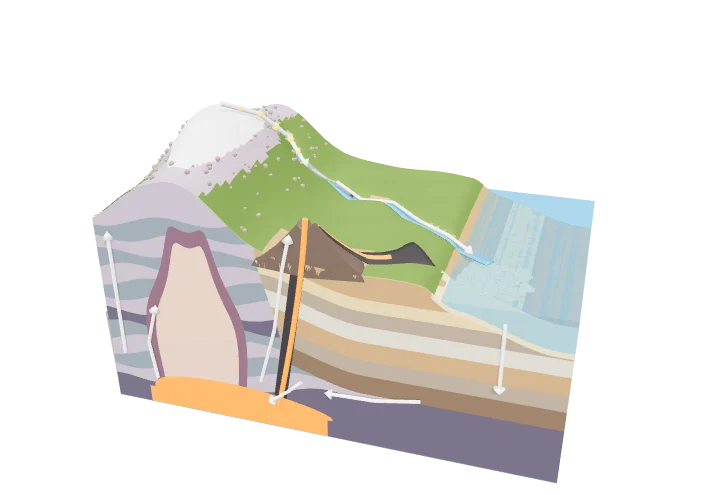
Rocks are not forever: they are slowly recycled. Melted rock cools into igneous rock, wind and water wear rock into sand and mud that harden into sedimentary rock, and heat and pressure deep underground squeeze rock into metamorphic rock. Given enough time, any rock can become any other.
The rock cycle describes how Earth materials are continually transformed between igneous, sedimentary and metamorphic rock by melting, crystallisation, uplift, weathering, erosion, deposition, lithification and metamorphism. It is driven by Earth’s internal heat (plate tectonics, magmatism) and by solar-powered surface processes (weather, water and ice), operating over timescales from hours to hundreds of millions of years.
Key facts
- Rock families
- Igneous, sedimentary, metamorphic
- Continental crust by volume
- ~95% igneous + metamorphic; sedimentary rocks a thin veneer
- Land surface covered by sedimentary rock
- ≈ 66–75%
- Granitic magma temperature
- ≈ 650–800 °C (basaltic 1100–1250 °C)
- Global sediment delivery by rivers
- ≈ 15–20 billion tonnes per year
- Typical mountain erosion rates
- ≈ 0.01–1 mm/yr (up to ~10 mm/yr in the Himalaya)
Parts you can explore (12)
- Magma
- Granite pluton
- Volcano and basalt flow
- Contact metamorphic aureole
- Metamorphic rock
- Sedimentary rock layers
- Weathering debris
- River
- Sea
- Deposited sediment
- Process arrows
- Moving rock particles
In the 3D model
Rotate and take apart the model, follow a guided tour of what each part does and why it’s needed, change it with a live slider, and test yourself with a short quiz. Free, no sign-up.
OpenArc Models’ models are simplified teaching schematics. Terms · Privacy