Mechanisms
Six-axis robot arm
Mechanisms · Robotics
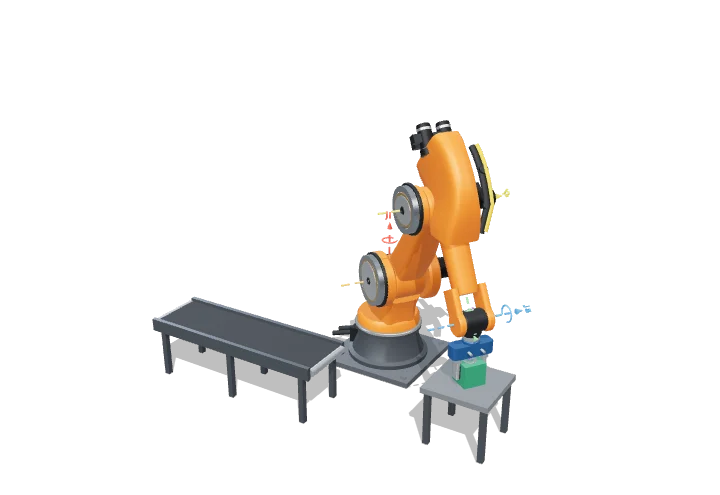 Open the interactive 3D model →
How does a factory robot pick up a part and set it down in exactly the same spot, thousands of times a day?
An industrial robot arm has six joints, each turned by its own electric motor, much like your shoulder, elbow and wrist. Three joints move the hand to the right place and three more tilt and twist it to the right angle. A computer works out every joint angle and moves them smoothly together, so the gripper lands within a fraction of a millimetre each time.
An articulated industrial robot chains six revolute joints so that its tool can reach any position and orientation within its workspace. The first three joints place the wrist centre, a spherical wrist orients the tool, and servo motors driving high-ratio strain-wave gears move each joint along smooth, pre-planned trajectories.
Key facts
- Degrees of freedom
- 6 revolute joints (3 position + 3 orientation)
- Wrist type
- Spherical: J4, J5, J6 axes intersect at one point
- Strain-wave gear ratio
- typically 50:1 to 160:1 in one stage (100:1 shown)
- Repeatability (industrial arms)
- typically ≈ ±0.02–0.1 mm
- Trajectory shape shown
- quintic polynomial in each joint between waypoints
- Model scale
- ≈ 1 unit = 0.5 m (≈ 1.05 m from shoulder to wrist centre)
Parts you can explore (11)
- Base
- Turret
- Upper arm
- Forearm
- Wrist
- Gripper
- Servo motors
- Harmonic drives
- Cable harness
- Joint axes
- Work cell
In the 3D model
Rotate and take apart the model, follow a guided tour of what each part does and why it’s needed, change it with a live slider, and test yourself with a short quiz. Free, no sign-up.
Open Six-axis robot arm in 3D →
OpenArc Models’ models are simplified teaching schematics. Terms · Privacy