Cells & molecules
Ribosome
Molecular biology · Translation
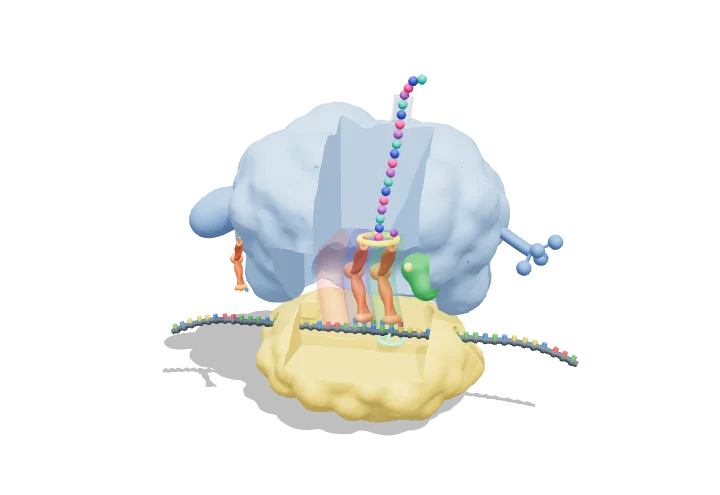 Open the interactive 3D model →
How does a cell turn a string of genetic letters into a working protein, one piece at a time?
Your genes are written in a four-letter code, but your body is built from proteins made of 20 kinds of building blocks called amino acids. The ribosome is the machine that reads a copied message (mRNA) three letters at a time and joins the matching amino acid onto a growing chain. Small adaptor molecules called tRNAs bring each amino acid and check that it matches the code.
The ribosome is a ribonucleoprotein machine that translates the codon sequence of mRNA into the amino-acid sequence of a protein. Each elongation cycle decodes one codon, forms one peptide bond and moves the tRNAs and mRNA one codon along.
Key facts
- Bacterial ribosome
- 70S = 50S + 30S, ≈ 2.5 MDa, ~20 nm
- Eukaryotic cytosolic ribosome
- 80S = 60S + 40S, ≈ 4.3 MDa, ~25–30 nm
- rRNA share of mass
- ≈ 2/3 (bacteria), ≈ 60% (eukaryotes)
- Elongation rate
- ≈ 15–20 aa/s (E. coli), ≈ 5–6 aa/s (mammals)
- Error rate
- ≈ 10⁻⁴–10⁻³ per codon
- GTP per elongation cycle
- 2 (EF-Tu and EF-G) + ATP used in tRNA charging
Parts you can explore (15)
- Large subunit
- Small subunit
- mRNA
- tRNAs
- A site
- P site
- E site
- Peptidyl transferase centre
- Decoding centre
- Exit tunnel
- Polypeptide
- L1 stalk
- L7/L12 stalk
- EF-Tu
- EF-G
In the 3D model
Rotate and take apart the model, follow a guided tour of what each part does and why it’s needed, change it with a live slider, and test yourself with a short quiz. Free, no sign-up.
OpenArc Models’ models are simplified teaching schematics. Terms · Privacy