Electromagnetism & electronics
Electromechanical relay
Electromechanical · Switching
 Open the interactive 3D model →
How can the tiny current from a light switch or a microchip safely turn on a big motor or heater?
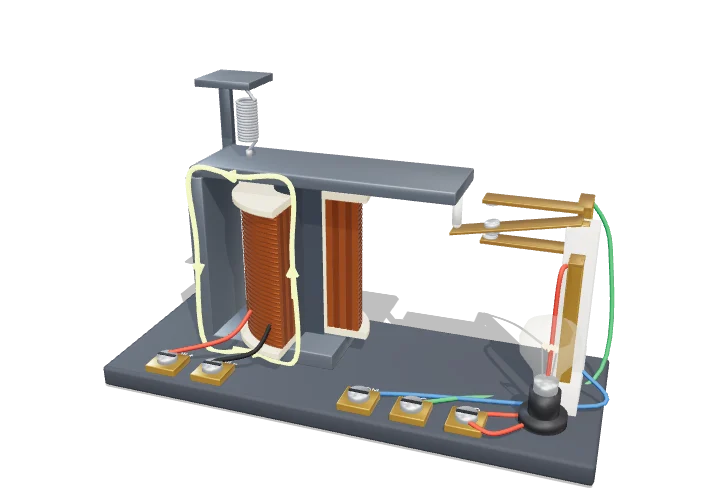
A relay is a switch worked by a magnet instead of a finger. A small current through its coil makes an electromagnet that pulls a metal plate down, and the plate pushes a springy contact from one position to another. The coil circuit and the switched circuit never touch, so a weak signal can safely control a powerful one.
An electromechanical relay uses a small coil current to magnetise an iron circuit, pulling a hinged armature across an air gap so that a moving contact changes from its normally-closed to its normally-open position. Because the coil and the contacts are electrically isolated, a few hundred milliwatts can switch kilowatts in a completely separate circuit.
Key facts
- Typical coil power
- ≈ 0.2–0.9 W (PCB relays)
- Typical contact rating
- ≈ 5–16 A at 250 V AC (general-purpose)
- Operate / release time
- ≈ 5–15 ms / ≈ 2–10 ms
- Must-operate voltage
- ≤ ≈ 70–80% of nominal
- Mechanical life
- ≈ 10⁷ operations (no load)
- Model coil
- 12 V, 400 Ω → 30 mA, 0.36 W; pull-in ≈ 9.0 V
Parts you can explore (10)
- Coil & core
- Yoke (frame)
- Armature
- Return spring
- Moving contact (COM)
- NC contact
- NO contact
- Magnetic flux
- Base & terminals
- Load lamp
In the 3D model
Rotate and take apart the model, follow a guided tour of what each part does and why it’s needed, change it with a live slider, and test yourself with a short quiz. Free, no sign-up.
Open Electromechanical relay in 3D →
OpenArc Models’ models are simplified teaching schematics. Terms · Privacy