Fluids & heat
Refrigerator
Thermodynamics · Vapour-compression cycle
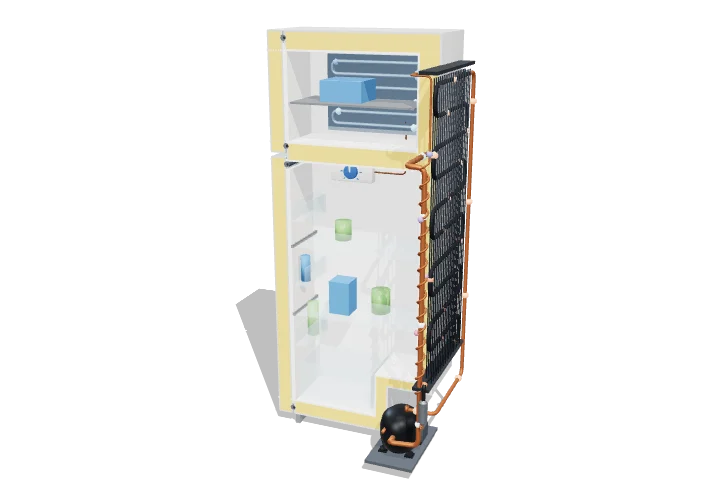 Open the interactive 3D model →
How does a fridge make things cold when all it has is electricity — and where does the heat go?
A fridge doesn’t make cold; it moves heat. A special fluid boils inside the freezer and soaks up heat from the food, then a pump squeezes it so it gets hot and gives that heat away through the pipes on the back. That is why the back of a fridge feels warm.
A household refrigerator is a heat pump that uses electrical work to move heat out of an insulated cabinet and reject it to the kitchen through the vapour-compression cycle. A refrigerant is compressed, condensed, throttled through a capillary tube and evaporated in the freezer, and a thermostat cycles the compressor to balance the heat that leaks in.
Key facts
- Target temperatures
- freezer ≈ −18 °C; fresh food ≈ 3–5 °C
- Evaporating / condensing
- ≈ −25 to −30 °C / ≈ +35 to +45 °C
- Refrigerant
- R600a (isobutane) in most new units; 20–60 g charge
- Compressor input
- ≈ 60–120 W while running
- Annual energy
- ≈ 150–300 kWh for a modern fridge-freezer
- Real COP
- ≈ 1–2 (Carnot limit ≈ 3.5 for the same temperatures)
Parts you can explore (12)
- Cabinet
- Insulation
- Doors
- Door seals
- Compressor
- Condenser
- Filter-drier
- Capillary tube
- Evaporator
- Suction line
- Thermostat
- Refrigerant flow
In the 3D model
Rotate and take apart the model, follow a guided tour of what each part does and why it’s needed, change it with a live slider, and test yourself with a short quiz. Free, no sign-up.
OpenArc Models’ models are simplified teaching schematics. Terms · Privacy