Physics
Refracting and reflecting telescopes
Optics · Instruments
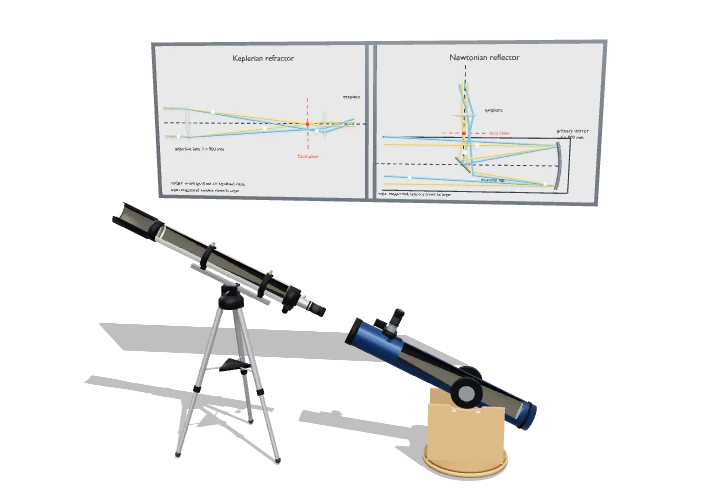 Open the interactive 3D model →
Does a telescope work by making things bigger — or by catching more light than your eye can?
A telescope uses a big lens or a curved mirror to collect much more light than the small pupil of your eye. It focuses that light into a tiny image, and a small magnifying lens called the eyepiece lets you look at it closely. The wider the main lens or mirror, the fainter and finer the things you can see.
A telescope’s objective — a lens in a refractor, a concave mirror in a reflector — gathers parallel light from distant objects and forms a real image at its focal plane, which the eyepiece then views as a magnifier. Angular magnification is f_obj/f_eye, but how faint and how fine a telescope can see is set by its aperture D.
Key facts
- Magnification
- M = f_obj / f_eye; 900 mm with a 25 mm eyepiece = 36×
- Light grasp vs the eye
- (D / 7 mm)²: ≈ 130× for 80 mm, ≈ 265× for 114 mm
- Diffraction limit (550 nm)
- 1.22 λ/D ≈ 1.7″ for 80 mm, ≈ 1.2″ for 114 mm
- Exit pupil
- D / M; best ≤ 7 mm (dark-adapted eye)
- Largest refractor
- 1.02 m Yerkes (1897)
- Largest single-mirror optical telescopes
- 8–10 m class (e.g. Subaru 8.2 m, LBT 8.4 m)
Parts you can explore (14)
- Objective lens
- Refractor tube
- Refractor focuser
- Eyepieces
- Alt-azimuth tripod
- Newtonian tube
- Primary mirror
- Secondary mirror
- Newtonian focuser
- Dobsonian mount
- Refractor ray diagram
- Refractor rays
- Newtonian ray diagram
- Newtonian rays
In the 3D model
Rotate and take apart the model, follow a guided tour of what each part does and why it’s needed, change it with a live slider, and test yourself with a short quiz. Free, no sign-up.
Open Refracting and reflecting telescopes in 3D →
OpenArc Models’ models are simplified teaching schematics. Terms · Privacy