Human body
Red blood cells
Blood · Erythrocytes
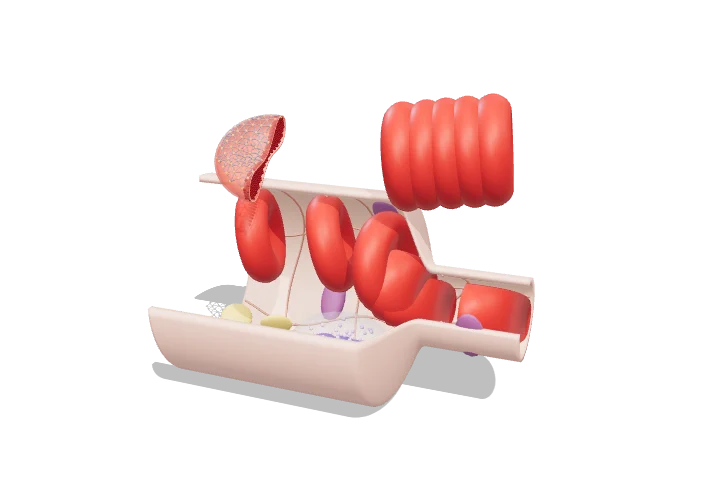 Open the interactive 3D model →
How does a red blood cell squeeze through a tube narrower than itself?
Red blood cells are tiny, dimple-shaped discs that carry oxygen from your lungs to every part of your body. They are so flexible that they fold up like a parachute to slip through the narrowest blood vessels, then spring back. Each one makes this trip hundreds of thousands of times in its four-month life.
Red blood cells are anucleate, biconcave discs packed with haemoglobin that carry oxygen from the lungs to the tissues and help return carbon dioxide. Their shape, spare membrane area and elastic spectrin skeleton let them fold through capillaries narrower than themselves hundreds of thousands of times during a 120-day life.
Key facts
- Diameter
- ≈ 7.5–8 µm
- Thickness
- ≈ 2–2.5 µm at the rim, ≈ 1 µm at the centre
- Volume (MCV)
- ≈ 80–100 fL
- Count
- ≈ 4.2–6.1 × 10⁶ per µL of blood
- Haemoglobin per cell
- ≈ 270 million molecules (~30 pg)
- Lifespan
- ≈ 120 days
Parts you can explore (9)
- Red blood cells
- Sectioned red blood cell
- Spectrin network
- Haemoglobin
- Rouleaux
- White blood cell
- Platelets
- Endothelium
- Plasma
In the 3D model
Rotate and take apart the model, follow a guided tour of what each part does and why it’s needed, change it with a live slider, and test yourself with a short quiz. Free, no sign-up.
OpenArc Models’ models are simplified teaching schematics. Terms · Privacy