Mechanisms
Ratchet and pawl
Mechanisms · One-way drives
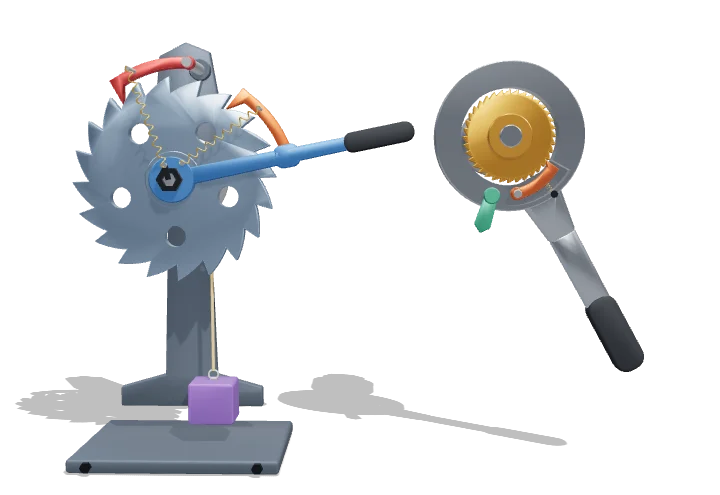 Open the interactive 3D model →
What makes a spanner click one way and grip the other, or a winch hold a heavy load without slipping?
A ratchet is a wheel with slanted teeth, like a row of shark fins, and a pawl is a little hinged catch that rests on them. Turned one way, the pawl slides up each slope and clicks over; turned the other way, it jams against a steep face. That lets a winch lift a load bit by bit without it running back down.
A ratchet and pawl lets rotation pass in one direction and blocks it in the other: the pawl slides over the sloping backs of asymmetric teeth but jams against their steep faces. Driving the wheel with a reciprocating pawl and holding it with a second pawl turns a back-and-forth stroke into intermittent one-way rotation in whole-tooth steps, as in winches, jacks, socket wrenches and freewheels.
Key facts
- Index angle per tooth
- p = 360°/N
- Teeth gained per stroke S
- n = ⌊S/p⌋
- Model winch
- 20 teeth, p = 18°
- Model socket wrench
- 36 teeth, p = 10°
- Typical socket wrench gear
- 36–120 teeth (72 is common, 5° swing)
- Pawls needed for a winch
- 2 (drive + holding)
Parts you can explore (13)
- Ratchet wheel
- Drive pawl
- Holding pawl
- Pawl springs
- Handle
- Frame
- Winch drum
- Load
- Wrench handle
- Wrench gear
- Wrench pawl
- Reversing lever
- Socket
In the 3D model
Rotate and take apart the model, follow a guided tour of what each part does and why it’s needed, change it with a live slider, and test yourself with a short quiz. Free, no sign-up.
OpenArc Models’ models are simplified teaching schematics. Terms · Privacy