Power & energy
Ramjet and scramjet
Propulsion · Air-breathing hypersonics
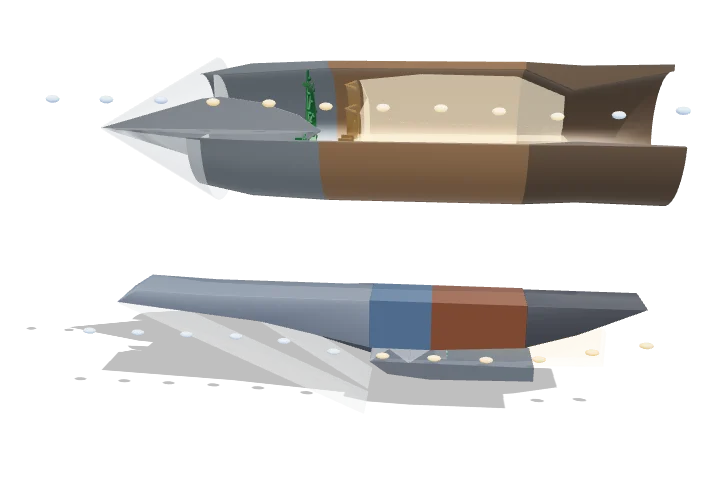 Open the interactive 3D model →
Can a jet engine work with no fan, no compressor and not a single moving part?
A ramjet and a scramjet squeeze air using nothing but their own enormous speed, like air piling up in front of your hand out of a car window. A ramjet slows the air down below the speed of sound before burning fuel in it. A scramjet is built for even higher speeds and burns fuel while the air is still rushing through faster than sound.
Ramjets and scramjets compress incoming air using only the vehicle’s speed, with shocks and duct shaping instead of a rotating compressor. A ramjet slows the air to subsonic speed before burning fuel and works best between about Mach 2 and 5, while a scramjet keeps the flow supersonic through the combustor and is the only practical air-breathing engine above about Mach 5–6.
Key facts
- Ramjet operating range
- ≈ Mach 1.5–5 (best ≈ 2.5–4)
- Scramjet operating range
- ≈ Mach 5–15 (demonstrated to 9.6)
- Ramjet combustor Mach number
- ≈ 0.2–0.3
- Scramjet combustor Mach number
- ≈ 2–4 at flight Mach 6–10
- Stagnation temperature at Mach 6 (T∞ = 220 K)
- ≈ 1,800 K
- Scramjet combustor residence time
- ≈ 1 ms
Parts you can explore (14)
- Ramjet inlet spike
- Ramjet cowl and diffuser
- Fuel injectors and flameholders
- Ramjet combustor
- Ramjet nozzle
- Ramjet shocks
- Scramjet forebody ramps
- Scramjet cowl
- Isolator
- Fuel injector struts
- Supersonic combustor
- Expansion nozzle
- Scramjet shocks
- Airflow
In the 3D model
Rotate and take apart the model, follow a guided tour of what each part does and why it’s needed, change it with a live slider, and test yourself with a short quiz. Free, no sign-up.
Open Ramjet and scramjet in 3D →
OpenArc Models’ models are simplified teaching schematics. Terms · Privacy