Power & energy
Radial aircraft engine
Engines · Nine-cylinder air-cooled radial
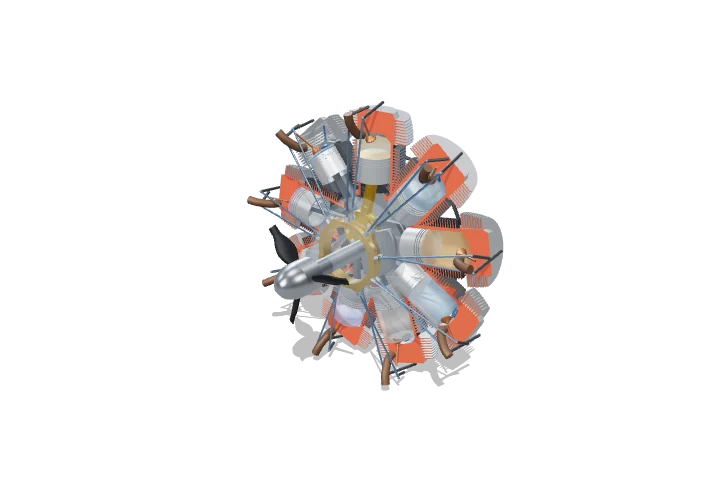 Open the interactive 3D model →
How can nine pistons, arranged in a star, all turn one tiny crank without getting tangled?
A radial engine has its cylinders arranged in a circle like the spokes of a wheel, all pushing on one crank in the middle. Only one rod is fixed to the crank; the other eight hang on pins around that rod’s end. The cylinders fire in a skipping pattern so the pushes come smoothly, one after another.
A radial engine arranges its cylinders like spokes around a single crankpin: one master rod runs on the crankpin and the other pistons drive it through articulated (link) rods pinned to the master-rod hub. With an odd number of cylinders the four-stroke engine can fire every other cylinder, 1-3-5-7-9-2-4-6-8, giving nine evenly spaced power strokes in two revolutions, while a single slowly counter-rotating cam ring times all the valves.
Key facts
- Cylinders
- 9 in one row, 40° apart
- Firing order / interval
- 1-3-5-7-9-2-4-6-8, every 80° of crank rotation
- Model geometry
- bore 132 mm × stroke 132 mm → ≈ 16.3 L (R-985 class)
- Cam ring
- 4 lobes per track, 1/8 crank speed, opposite rotation
- Typical output (this size)
- ≈ 300–330 kW (400–450 hp) at ≈ 2200–2300 rpm
- Cooling
- Air: finned cylinders in the slipstream
Parts you can explore (15)
- Crankcase
- Cylinders
- Cylinder heads
- Pistons
- Master rod
- Articulated rods
- Crankshaft
- Cam ring
- Pushrods
- Valves
- Nose case
- Propeller hub
- Intake pipes
- Exhaust stacks
- Combustion gases
In the 3D model
Rotate and take apart the model, follow a guided tour of what each part does and why it’s needed, change it with a live slider, and test yourself with a short quiz. Free, no sign-up.
Open Radial aircraft engine in 3D →
OpenArc Models’ models are simplified teaching schematics. Terms · Privacy