Mechanisms
Rack and pinion
Power transmission · Rotary ↔ linear
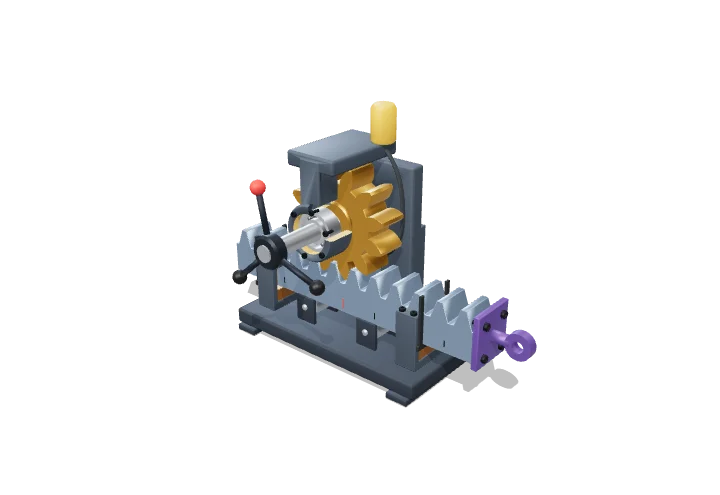 Open the interactive 3D model →
How does turning a steering wheel make a car’s front wheels slide left and right?
A rack and pinion turns a twist into a straight push. A small round gear, the pinion, meshes with a flat bar of teeth, the rack. As the pinion turns, its teeth walk the rack sideways, one tooth at a time.
A rack and pinion converts rotation into straight-line motion (or the reverse) by meshing a round gear with a straight gear of infinite radius. Because the pinion’s pitch circle rolls without slip along the rack’s pitch line, rack travel is x = r·θ and rack force is pinion torque divided by pitch radius.
Key facts
- Kinematics
- x = r θ, v = r ω
- Model pinion
- 12 teeth, module 2.5 mm, pitch radius 15 mm (+0.3 profile shift)
- Travel per pinion turn (model)
- 2π × 15 mm ≈ 94.2 mm
- Tooth spacing (circular pitch)
- p = π m ≈ 7.85 mm in the model
- Car overall steering ratio
- ≈ 12 : 1 – 20 : 1
- Mesh efficiency
- ≈ 90–98% in both directions (back-drivable)
Parts you can explore (12)
- Pinion (12T)
- Rack
- Input shaft & knob
- Housing
- Input bearing
- Rear bearing
- Guide rollers
- Rack guides & wipers
- Rack mounting plate
- Housing fasteners
- Lubricator
- Rack position sensor
In the 3D model
Rotate and take apart the model, follow a guided tour of what each part does and why it’s needed, change it with a live slider, and test yourself with a short quiz. Free, no sign-up.
OpenArc Models’ models are simplified teaching schematics. Terms · Privacy