Electromagnetism & electronics
Quartz watch movement
Electronics · Oscillators
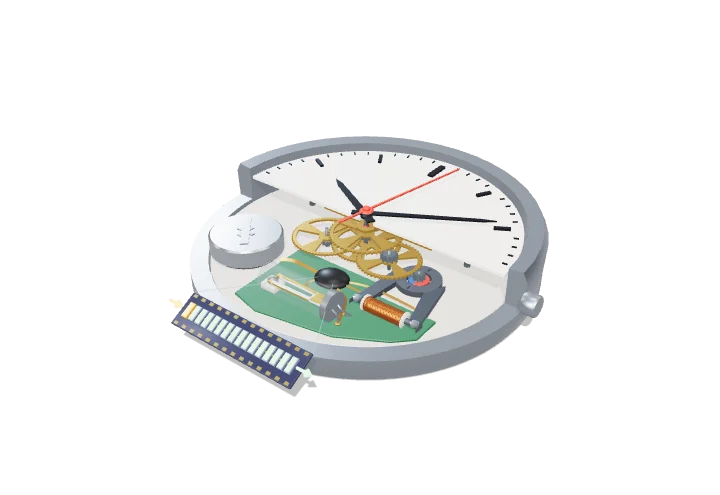 Open the interactive 3D model →
How does a cheap watch keep time to within a few seconds a month?
Inside a quartz watch is a tiny tuning fork made of quartz crystal that vibrates exactly 32,768 times every second. A small chip counts those vibrations and, every time it reaches 32,768, sends one electric pulse to a tiny motor. The motor nudges the seconds hand forward one tick.
A quartz watch keeps time by counting the vibrations of a piezoelectric quartz tuning fork that resonates at 32,768 Hz. A CMOS chip sustains the oscillation, divides it by 2¹⁵ to one pulse per second, and drives a Lavet stepper motor whose rotor advances the hands through a gear train.
Key facts
- Crystal frequency
- 32,768 Hz = 2¹⁵ Hz
- Divider stages
- 15 divide-by-two flip-flops → 1 Hz
- Typical accuracy
- ≈ ±15 s per month (≈ 6 ppm)
- Resonator Q (in vacuum)
- ≈ 10⁴–10⁵
- Motor step
- 180° rotor step per second → 6° on the seconds hand
- Average current
- ≈ 1–1.5 µA from a 1.55 V silver-oxide cell
Parts you can explore (14)
- Quartz tuning fork
- Electrodes
- Crystal can
- Oscillator IC
- Divider chain
- Circuit board
- Battery
- Stepper coil
- Stator
- Rotor magnet
- Gear train
- Hands
- Dial
- Case and mainplate
In the 3D model
Rotate and take apart the model, follow a guided tour of what each part does and why it’s needed, change it with a live slider, and test yourself with a short quiz. Free, no sign-up.
Open Quartz watch movement in 3D →
OpenArc Models’ models are simplified teaching schematics. Terms · Privacy